
Search
Remove Ads
Advertisement
Search Results

Image
Villanovan House Funerary Urn
A terracotta funerary urn in the form of a house from the Villanovan culture of central Italy. 8th century BCE. (Walters Art Museum, Baltimore, USA)

Video
Let's Explore the King's House in the Forum: the REGIA - Ancient Rome Live
The Regia was an old (7th Century BCE) structure that may have first been the king's house in the regal period. By the time of the Augustus, it took on its definitive appearance...

Article
The Ancient Celtic Pantheon
The ancient Celtic pantheon consisted of over 400 gods and goddesses who represented everything from rivers to warfare. With perhaps the exception of Lugh, the Celtic gods were not universally worshipped across Iron Age...

Article
Montpellier during the French Reformation
At the dawn of the French Wars of Religion (1562-1598), Montpellier in southern France had a significant Protestant minority that controlled the city's institutions. The Edict of Nantes in 1598 ended the wars...

Definition
Sophocles
Sophocles of Kolōnos (c. 496 - c. 406 BCE) was one of the most famous and celebrated writers of tragedy plays in ancient Greece and his surviving works, written throughout the 5th century BCE, include such classics as Oedipus Rex...
Definition
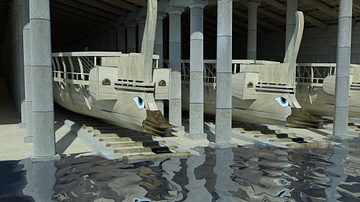
Piraeus - The Ancient Port of Athens
Piraeus (or Peiraieus) was the ancient port of Athens throughout the Archaic, Classical and Hellenistic periods and in fact consisted of three separate harbours - Kantharos, Zea, and Munichia. The first was the...

Definition
Roman Architecture
Roman architecture continued the legacy left by Greek architects and the established architectural orders, especially the Corinthian. The Romans were also innovators and they combined new construction techniques and materials...

Definition
Inti
Inti was the Inca god of the sun and considered all-powerful but he was also a benevolent god and capable of great generosity. However, Inti could be angered and he would demonstrate his displeasure through solar eclipses which necessitated...

Definition
Crates of Thebes
Crates of Thebes (l. c. 360-280 BCE) was one of the most important Cynic philosophers of ancient Greece. He was born to a wealthy family in Thebes but gave away his inheritance after realizing the futility of material possessions...

Definition
Nisaba - Sumerian Goddess of Writing and Scribe of the Gods
Nisaba (also Naga, Se-Naga, Nissaba, Nidaba, and associated with Nanibgal) is the Sumerian goddess of writing, accounts, and scribe of the gods. Although her name is commonly given as Nidaba...
