
Search
Remove Ads
Advertisement
Search Results

Definition
Brahmanism
Brahmanism (also known as Vedic Religion) is the belief system that developed from the Vedas during the Late Vedic Period (c. 1100-500 BCE) originating in the Indus Valley Civilization after the Indo-Aryan Migration c. 2000-1500 BCE...

Definition
Aztec Sacrifice - How the Aztecs Kept Their Gods Happy
The religion of the Aztec civilization which flourished in ancient Mesoamerica (1345-1521 CE) has gained an infamous reputation for bloodthirsty human sacrifice with lurid tales of the beating heart...

Definition
Inti
Inti was the Inca god of the sun and considered all-powerful but he was also a benevolent god and capable of great generosity. However, Inti could be angered and he would demonstrate his displeasure through solar eclipses which necessitated...

Definition
Egyptian Book of the Dead
The Egyptian Book of the Dead is a collection of spells which enable the soul of the deceased to navigate the afterlife. The famous title was given the work by western scholars; the actual title would translate as The...

Definition
Cherub
A cherub (pl. cherubim) was a divine being who dwelt in the heavenly realm of the gods, either as a servant or a mediator between humans and the divine. The word most likely derived from the Akkadian karabu ("to bless"). The cherubim...

Definition
Buddhism
Buddhism is a non-theistic religion (no belief in a creator god), also considered a philosophy and a moral discipline, originating in the region of modern-day India in the 6th and 5th centuries BCE. It was founded by the sage Siddhartha...
Definition
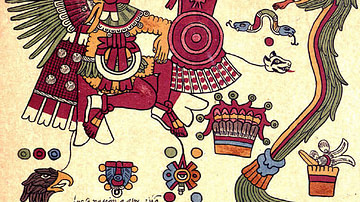
Xipe Totec
Xipe Totec (pron. Xi-pe To-tec) or 'Flayed One' in Nahuatl, was a major god in ancient Mesoamerican culture and particularly important for the Toltecs and Aztecs. He was considered the god of spring, the patron god of seeds and planting...

Definition
Neith
Neith (aka Net, Neit or Nit) and is one of the oldest deities of ancient Egypt who was worshipped early in the Pre-Dynastic Period (c. 6000 - 3150 BCE) and whose veneration continued through the Ptolemaic Dynasty (323 - 30 BCE), the last...

Definition
Kami
In the Shinto religion kami is an all-embracing term which signifies gods, spirits, deified mortals, ancestors, natural phenomena, and supernatural powers. All of these kami can influence people's everyday lives and so they are worshipped...

Definition
Ninigi
Ninigi-no-Mikoto, or simply Ninigi, is the grandson of the supreme Shinto deity Amaterasu, the sun goddess. He is the son of Ama-no-Oshiho-mimi and, descending to earth as the first just ruler, he brought with him gifts from Amaterasu...
