
Search
Remove Ads
Advertisement
Search Results

Article
Continuity and Change after the Fall of the Roman Empire
The cataclysmic end of the Roman Empire in the West has tended to mask the underlying features of continuity. The map of Europe in the year 500 would have been unrecognizable to anyone living a...

Image
Yazilikaya Engraving with Hittite Gods
Engraving from a relief at Yazilikaya by French archaeologist Charles Texier (1882). Teshub stands on two deified mountains (depicted as men) alongside his wife Hepatu, who is standing on the back of a panther...

Definition
Near East - A Modern Term for an Ancient Land
The 'Near East' is a modern-age term for the region formerly known as the 'Middle East,' comprising Armenia, Cyprus, Egypt, Iraq, Iran, Israel, Jordan, Lebanon, Palestine, Syria, and part of Turkey, corresponding...

Definition
Mauryan Empire
The Mauryan Empire (322 BCE - 185 BCE) supplanted the earlier Magadha Kingdom to assume power over large tracts of eastern and northern India. At its height, the empire stretched over parts of modern Iran and almost the entire...

Definition
Lycia
Lycia is a mountainous region in south-west Anatolia (also known as Asia Minor, modern-day Turkey). The earliest references to Lycia can be traced through Hittite texts to sometime before 1200 BCE, where it is known as the Lukka Lands...

Definition
Empire
An empire is a political construct in which one state dominates over another state, or a series of states. At its heart, an empire is ruled by an emperor, even though many states in history without an emperor at their head are called...

Image
The Sphinx Gate, Alacahöyük (Hittite settlement)
The Sphinx Gate at Alacahöyük (the site of a Neolithic and Hittite settlement in central Turkey) was built in the 14th century BCE. It was the south entrance of the city and was fortified with towers...

Image
Hittite War Chariot
Relief orthostat (stone slab at base of wall) of war chariot from Sam'al (Turkey), west side of citadel gate; Basalt; Late Hittite period (9th cent BCE); Museum of the Ancient Orient, Istanbul Archaeological Museums.
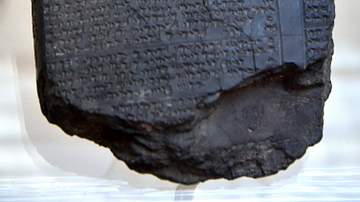
Image
The Hittite Laws Tablet from Hattusa
This tablet's text is one of the latest versions of the Hittite laws text. In spite of some modifications (for example from the 16th century BCE versions), the articles of these two versions run parallel to each...

Image
Hittite Relief of Musicians
This basalt wall relief depicts four people playing on musical instruments. From Sam'al (modern-day Sinjerli, Gaziantep, Turkey). Late Hittite period, 8th century BCE. (Istanbul Archeological Museums/Ancient Orient Museum...
