
Search
Remove Ads
Advertisement
Search Results
Image
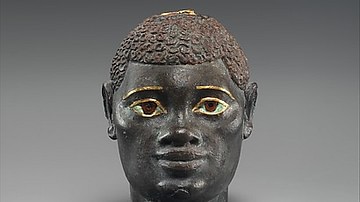
Hellenistic Head of an Aethiopian
This beautifully crafted head portrays an "Aethiopian", or black African, and is made out of black bronze, gold, obsidian and carnelian. The piece was once a part of an ornate object like a serving dish although it has been broken off at...

Image
Three Hellenistic Heads, Cyprus
Three heads of worshippers from the Temple of Apollo-Reshef, Cyprus, 350-250 BCE. Early Hellenistic style. (British Museum, London)
Image
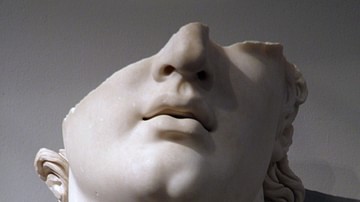
Hellenistic Colossal Head of a Youth
Fragmentary colossal head of a youth, from the Pergamon Gymnasium, Hellenistic period, 2nd century BCE (Pergamon Museum, Berlin)
Image
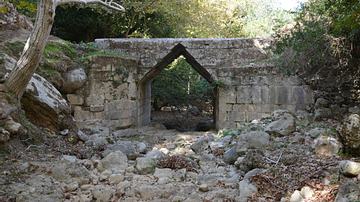
Hellenistic Bridge at Eleutherna, Crete
The Eleutherna Bridge on Crete is a well-preserved Hellenistic corbel arch bridge with a single span of 3.95 m. It was built with large limestone blocks in dry masonry around 330 - 367 BCE when a major construction project took place at Eleutherna...

Image
The Classical Orders of Architecture - From Greece to Rome, the Five Pillars of Architectural Design
The five classical orders of architecture: Doric, Ionic, Corinthian, Tuscan, and Composite, form a codified system of proportion, decoration, and structural logic that emerged in the Greek world (c. 7th–4th centuries BCE) and was later adapted...
Image
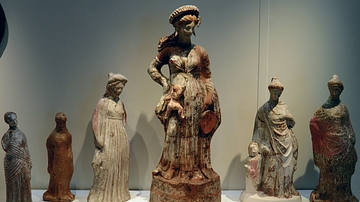
Hellenistic Terracotta Figurines from Pella
Terracotta figurines of women with their ordinary clothes and adornments, 2nd century BCE (Pella Archaeological Museum).

Image
The Doric Order, Classical Orders of Architecture
The Classical Orders of Architecture (Doric, Ionic, Corinthian, Tuscan, and Composite), originating in ancient Greece and refined by the Romans, are fundamental design principles that significantly influence classical and neoclassical structures...
Image
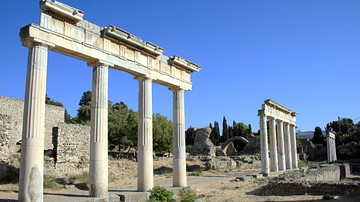
The Hellenistic Gymnasium, Kos
The remaining columns of the Hellenistic period gymnasium, Kos.
Image
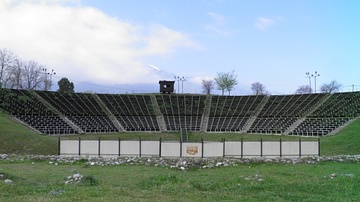
Dion Hellenistic Theatre, Greece
The Hellenistic Theatre at Dion in Macedon with Mount Olympus in the background. The theatre was built into a natural hill during the 3rd century BCE. It underwent several phases of modification during the reign of Philip V (r. 221-179 BCE...
Image
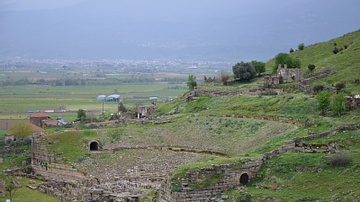
The Hellenistic Theatre of Alabanda
The Hellenistic theatre of Alabanda, located on a natural south-facing hillside. The theatre could hold 6,000 spectators in its early phase. In the Imperial period, gladiator and animal combats were increasingly in demand and a new design...
