
Search
Remove Ads
Advertisement
Search Results

Article
Diversity in Church Architecture in Medieval England
Medieval English churches differed in size and layout. Their original and evolving role(s), financial and material resources, and architectural fashions helped determine variability. However, their look ultimately grew from a constant symbiosis...

Image
Map of the Hellenistic Kingdoms after Alexander, c.301 BCE
The Hellenistic Successor Kingdoms (the Diadochi, from the Greek for “Successors”) emerged after the death of Alexander the Great in 323 BCE, when his vast empire fractured among his generals. From this division arose powerful states such...

Image
The Hellenistic Prince (Detail)
The head of the 2nd century BCE bronze statue known as 'The Hellenistic Prince'. The statue perhaps represents Attalus II, king of Pergamon. The head may also be a portrait of an unknown wealthy Roman, eager to appear as a Hellenistic prince...

Image Gallery
A Gallery of Chinese Art & Architecture
Chinese culture developed from small communities such as Banpo Village (c. 4500 BCE) through the early Xia Dynasty (c. 2070-1600 BCE) and the great dynastic periods that followed after, creating some of the most striking and memorable works...
Image
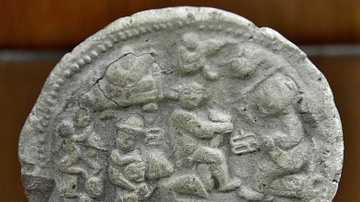
Pottery Plaque from the Hellenistic Period
This round pottery plaque depicts various human daily activities. In the middle, a man and a woman are having sex, and on the left, a standing woman holds a young child on her shoulders. Hellenistic Period, 323-30 BCE. From Mesopotamia, modern-day...

Image
Hellenistic Trade Routes, 300 BCE
Alexander the Great died in Babylon on the 13th of June, 323 BCE. His Macedonian-Greek empire broke apart, but Alexander’s heritage was felt throughout the ancient Mediterranean world for centuries. Three Hellenic empires emerged from the...

Definition
Leon Battista Alberti
Leon Battista Alberti (1404-1472 CE) was an Italian scholar, architect, mathematician, and advocate of Renaissance humanism. Alberti famously wrote the treatise On Architecture where he outlines the key elements of classical architecture...
Image
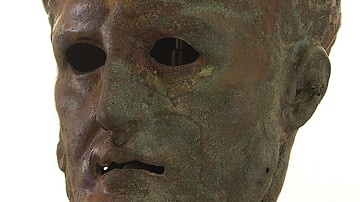
Hellenistic Prince, Brundisium
A bronze figure known as the Hellenistic Prince, Brundisium, southern Italy, 2nd-1st century BCE. (Archaeological Museum of Brindisi, Italy)
Image
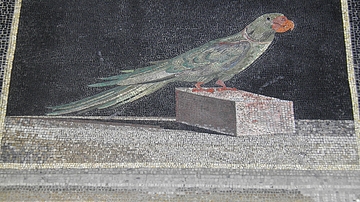
Hellenistic Mosaic, Pergamon
Hellenistic mosaic floor panel depicting an Alexandrine parakeet from Pergamon (modern Turkey), 2nd century BCE (Pergamon Museum).
Image
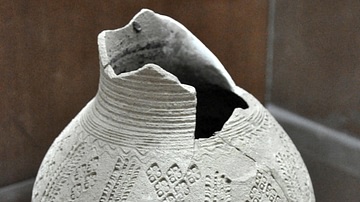
Pottery Jar from Hellenistic period
This partially broken jar dates back to the Hellenistic period, 323-30 BCE. From Mesopotamia, Iraq. (The Sulaimaniya Museum, Iraq).
