
Search
Remove Ads
Advertisement
Search Results
Definition
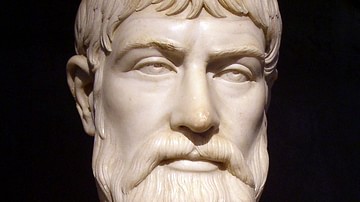
Pindar
Pindar (c. 518 to c. 448/7 BCE) was an ancient Greek lyric poet, probably the greatest of his time. His works have been divided into 17 books of different types of poetry, but only those containing 44 choral victory songs composed for...

Definition
Pasiphaë
Pasiphaë ("all-shining") is the wife of King Minos of Crete and the mother of the fearsome Minotaur (half-bull, half-man creature) in Greek mythology. She is the daughter of the sun god Helios and Perse, an Oceanid. Like her sister...

Definition
Hesperides
The Hesperides are nymph-goddesses of the evening and the west in Greek mythology. They were the daughters of Atlas, the Titan who bore the heavens on his shoulders, and Hesperis, the personification of the west, or Nyx, the personification...

Definition
Parthenon - Temple of Athena Parthenos
The magnificent temple on the Acropolis of Athens, known as the Parthenon, was built between 447 and 432 BCE in the Age of Pericles, and it was dedicated to the city's patron deity Athena Parthenos. The temple...

Definition
Samothrace
Samothrace (Samothrake) is a Greek island in the northern Aegean which was prominent from the Classical period as a member of the Delian League. Its greatest claim to fame was as a cult centre favoured by Macedon and visited by pilgrims...

Definition
Cadmus
Cadmus is a Phoenician-born prince and the founder and king of Thebes in Boeotia in Greek mythology. He travelled to Greece from his home in Tyre in search of his sister Europa who had been kidnapped by Zeus. His rescue mission was abandoned...

Definition
Hecate
Hecate (Hekate) is a goddess of Greek mythology capable of both good and evil. She was associated with witchcraft, magic, the Moon, doorways, and creatures of the night like hell-hounds and ghosts. Hecate often carries a torch in her...
Definition
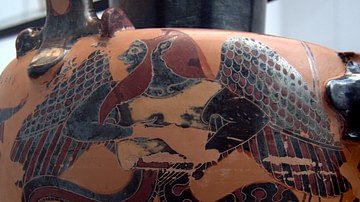
Typhon
Typhon (also Typheus) is the largest and most dreadful monster in Greek mythology. He was tall, with a brutish face, and had wings, countless snakeheads in place of hands, and a lower body made up of coiled serpents. His eyes flashed...

Definition
Midas - The Mythical King with the Golden Touch
Midas was a mythical king of Phrygia in Asia Minor who was famous for his extraordinary ability to change anything he touched into gold. This gift was given to him by Dionysos in thanks for his hospitality...

Definition
Hellenistic Warfare
When Alexander the Great died in 323 BCE, he left behind an empire devoid of leadership. Without a named successor or heir, the old commanders simply divided the kingdom among themselves. For the next three decades, they fought...
