
Search
Remove Ads
Advertisement
Search Results

Definition
Orpheus
Orpheus is a figure from ancient Greek mythology, most famous for his virtuoso ability in playing the lyre or kithara. His music could charm the wild animals of the forest, and even streams would pause and trees bend a little closer...

Definition
Runes
Runes are letters in the runic alphabets of Germanic-speaking peoples, written and read most prominently from at least c. 160 CE onwards in Scandinavia in the Elder Futhark script (until c. 700 CE) and the Younger Futhark - which illuminated...

Definition
Saint Cyril
Saint Cyril (aka Kyrillos and Constantine the Philosopher, d. 867 CE) was a Byzantine linguist, teacher, scholar and missionary who famously preached Christianity to the Slavs in Moravia with his brother Methodius during the 9th century...

Definition
Eris
Eris is the Greek goddess and personification of discord and strife. She is an unpopular figure in Greek mythology due to her problematic behaviour and her ability to stir up trouble wherever she goes. Eris is most famous for her Golden...

Definition
Patroclus
Patroclus is a figure from Greek mythology who fought in the Trojan War and was most famous for his close friendship with the Greek hero, Achilles. He followed Achilles to Troy and would ultimately die because of him and his actions...

Definition
Diomedes
Diomedes is the king of Argos and a hero in Greek mythology. He was one of the leading warriors in the Trojan War, with the reputation of being gifted and strong in combat. He contributed 80 ships to the Greek forces in the Trojan War...

Definition
Sarpedon
Sarpedon is a figure from ancient Greek mythology, a Lycian prince who was one of the principal heroes during the Trojan War and fought on the side of Troy. According to Homer's Iliad, he was the son of Zeus by Laodameia and the cousin...

Definition
Temple of Artemis at Ephesus
The Temple of Artemis at Ephesus was located on the western coast of Asia Minor (modern Turkey) and built in the 6th century BCE. Such was its tremendous size, double the dimensions of other Greek temples including the...

Definition
Xenophon
Xenophon of Athens (l. 430 to c. 354 BCE) was a contemporary of Plato and a fellow student of Socrates. He is best known for his Anabasis (The March Up Country) detailing the retreat of the Ten Thousand Greek mercenaries after the defeat...
Definition
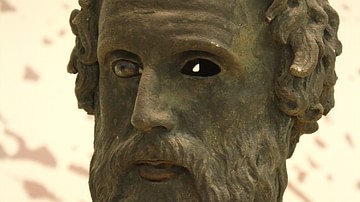
Gorgias
Gorgias (l. c. 427 BCE) was a Greek Sophist and philosopher, considered the greatest Rhetorician of his day. He is said to have created several aspects of public speaking still in use and to have mastered the art of persuasion, commanding...
