
Search
Remove Ads
Advertisement
Search Results

Definition
Medea (Play)
The tragedy Medea was written in 431 BCE by Euripides (c. 484 – 407 BCE). Euripides authored at least 90 plays of which 19 have survived intact. As with the plays by Sophocles and Aeschylus, the audience was already well aware of...

Definition
Agamemnon (Play)
The play Agamemnon was written by one of the greatest Greek tragedians Aeschylus (c. 525 – 455 BCE), “Father of Greek Tragedy.” Older than both Sophocles and Euripides, he was the most popular and influential of all tragedians...

Definition
Ancient Egyptian Government
The government of ancient Egypt was a theocratic monarchy as the king ruled by a mandate from the gods, initially was seen as an intermediary between human beings and the divine, and was supposed to represent the gods'...

Definition
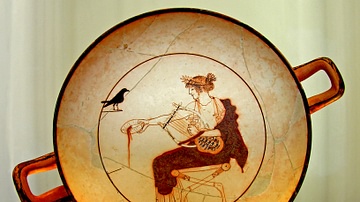
Hestia
Hestia was the Greek virgin goddess of the hearth, home, and hospitality. In Greek mythology, she is the eldest daughter of Cronus and Rhea. In her role as a protector of the family and political community, sacrifices and offerings were...
Definition
Lyre
The lyre was a stringed musical instrument played by the ancient Greeks. It was probably the most important and well-known instrument in the Greek world. The lyre was closely related to the other stringed instruments: the chelys which...

Definition
Theogony
The Theogony is an 8th-century BCE didactic and instructional poem, credited to the Greek poet Hesiod. The Theogony was, at first, not actually written down, rather, it was part of a rich oral tradition which only achieved written form...

Definition
Magna Graecia
Magna Graecia (Megalē Hellas) refers to the coastal areas of southern Italy which were colonized by various ancient Greek city-states from the 8th to 5th centuries BCE. Sicily, although also a region of Greek colonization, is not...

Definition
Philosophy
The word philosophy comes from the Greek philo (love) and sophia (wisdom) and so is literally defined as "the love of wisdom". More broadly understood, it is the study of the most basic and profound matters of human existence. Philosophical...

Definition
Mystras
The city of Mystras (or Mistras) in southern Greece was the provincial capital of the Byzantine Despotate of the Morea from the 13th through the 15th centuries CE. It was founded in 1249 CE by William II of Villehardouin, and it served...

Definition
Etruscan Art
The art of the Etruscans, who flourished in central Italy between the 8th and 3rd century BCE, is renowned for its vitality and often vivid colouring. Wall paintings were especially vibrant and frequently capture scenes of Etruscans...
