
Search
Remove Ads
Advertisement
Search Results

Definition
Proclus
Proclus of Athens (c. 412-485 CE) was a prolific Platonic philosopher whose main aim was the seemingly impossible task of defending traditional Greek polytheism at the time when his contemporary culture was almost completely dominated...

Definition
Apollo
Apollo was a Greek god associated with the bow, music, and divination. The epitome of youth and beauty, source of life and healing, patron of the arts, and as bright and powerful as the sun itself, Apollo was perhaps the most loved of...

Definition
Helen of Troy
Helen of Troy (sometimes called Helen of Sparta) is a figure from Greek mythology whose elopement with (or abduction by) the Trojan prince Paris sparked off the Trojan War. Helen was the wife of Menelaus, the king of Sparta, and...

Definition
Trojan War
The Trojan War was fought between Greeks and the defenders of the city of Troy in Anatolia sometime in the late Bronze Age. The story has grabbed the imagination for millennia but a conflict between Mycenaeans and Hittites may well...

Definition
Hestia
Hestia was the Greek virgin goddess of the hearth, home, and hospitality. In Greek mythology, she is the eldest daughter of Cronus and Rhea. In her role as a protector of the family and political community, sacrifices and offerings were...
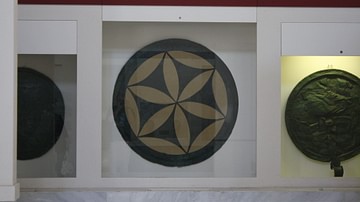
Image
Greek Bronze Shield
Bronze shield from Olympia, 6th century BCE.
Olympia Archaeological Museum.

Image
Greek Athlete With Strigil
Red figure skyphos or cup (410 BCE) depicting a nude athlete holding a strigil - used to clean the body of oil, dust and sweat after exercise. To the left is possibly a mid-race marker post. Attributed to the Amykos painter...
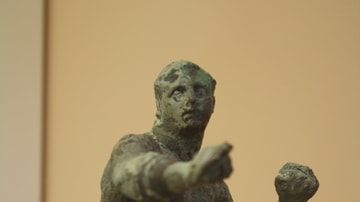
Image
Greek Pankratiast
A bronze statue of a pankratiast (2nd century BCE). The leather thongs wrapped around the fist, worn by later exponents of this viiolent mix of wrestling and boixing, can be clearly seen. (Olympia Archaeological Museum, Olympia...
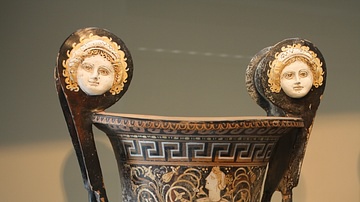
Image
Greek Volute Krater
This vessel was used to mix wine and water and dates from the second half of the fourth century BCE. Provenance: Apula. Depicted are two female figures with gifts approaching a deceased person seated on a funeral monument...
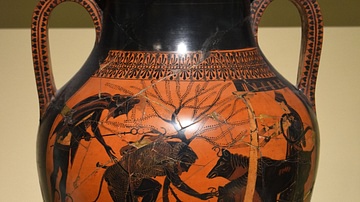
Image
Black Figured Greek Amphora
This black figured amphora was made by the Andokides Painter of Attica, and it dates from c. 530 BCE. It is made of clay and special glaze. (Pushkin Museum, Moscow)
