
Search
Remove Ads
Advertisement
Search Results

Article
Interview: Medieval Christian Art in the Levant
Medievalists retain misconceptions and myths about Oriental Christians. Indeed, the fact that the Middle East is the birthplace of Christianity is an afterthought for many. During the Middle Ages, Christians...

Definition
Periplus of the Erythraean Sea
The Periplus of the Erythraean Sea is an eyewitness account of ancient travel to Africa and India via the Red Sea written by an unknown Greek-speaking Egyptian author in the 1st century CE. In this detailed account...

Definition
Persepolis
Persepolis was the capital of the Persian Achaemenid Empire from the reign of Darius I (the Great, r. 522-486 BCE) until its destruction in 330 BCE. Its name comes from the Greek Perses-polis (Persian City), but the Persians knew...

Definition
Ancient Timekeeping
The passage of time has always been a preoccupation of human beings, whether it be a question of satisfying basic needs such as when to eat and sleep, the importance of seasons for migratory and agricultural purposes or a more...

Definition
Polis - The City-State of Ancient Greece
A polis (plural: poleis) was the typical structure of a community in the ancient Greek world. A polis consisted of an urban centre, often fortified and with a sacred centre built on a natural acropolis or harbour...

Definition
Minotaur
In Greek mythology, the Minotaur was a monster with the body of a man and the head and tail of a bull. The Minotaur was the offspring of the Cretan Queen Pasiphae and a majestic bull. Due to the Minotaur's monstrous form, King Minos...

Definition
Nike - Greek Goddess of Victory
The ancient Greek goddess Nike was the personification of the ideal of victory. Such personifications of ideal terms were common in ancient Greek culture; other examples include Wisdom, Knowledge, and Justice. Unlike...
Definition
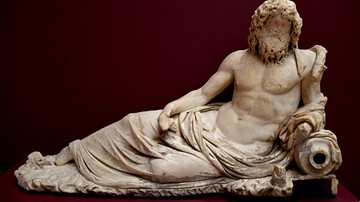
Oceanus
Oceanus (also Okeanos) was the eldest of the Titans and a son of Uranus (Heaven) and Gaia (Earth) in Greek mythology. He was the god and personification of the freshwater river Oceanus, which was thought to encircle the earth and was...

Definition
Anaxagoras
Anaxagoras (l. c. 500-c. 428 BCE) was a Pre-Socratic Greek philosopher who claimed the First Cause of existence was Mind (nous) and all things were constituted of indestructible “seeds” (or “stuff”), originally a single mass, separated...

Definition
Pre-Socratic Philosophers
The Pre-Socratic Philosophers are defined as the Greek thinkers who developed independent and original schools of thought from the time of Thales of Miletus (l. c. 585 BCE) to that of Socrates of Athens (470/469-399 BCE...
