
Search
Did you mean: God?
Remove Ads
Advertisement
Search Results

Definition
Ahuitzotl
Ahuitzotl (Auitzotl) was an Aztec ruler who reigned between 1486 and 1502 CE. He was one of the greatest generals of the ancient Americas and he left to his nephew, Montezuma, an enlarged and consolidated empire which had been ruthlessly...
Definition
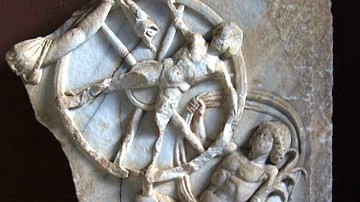
Ixion - The Man Who Was Tied to an Ever-Spinning Wheel
Ixion is the fiendishly wicked king of the Lapiths from Greek mythology. In an attempted seduction of Hera, he was tricked by Zeus into making love to a cloud instead, from which was born Centaurus...

Definition
Ptolemaic Egypt
Ptolemaic Egypt existed between 323 and 30 BCE when Egypt was ruled by the Macedonian Ptolemaic dynasty. During the Ptolemaic period, Egyptian society changed as Greek immigrants introduced a new language, religious pantheon...

Definition
Cherub
A cherub (pl. cherubim) was a divine being who dwelt in the heavenly realm of the gods, either as a servant or a mediator between humans and the divine. The word most likely derived from the Akkadian karabu ("to bless"). The cherubim...

Definition
Ptolemy II Philadelphus
Ptolemy II Philadelphus ("The Sibling Loving", r. 282-246 BCE) was the second ruler of the Ptolemaic Dynasty. He consolidated the kingdom conquered by his father Ptolemy I and presided over its golden age. Ptolemy II invested...

Definition
Ancient Greek Literature
Greek literature has influenced not only its Roman neighbors to the west but also countless generations across the European continent. Greek writers are responsible for the introduction of such genres as poetry, tragedy...

Image
The Twelve Elder Titans in Greek Mythology - according to Theogony (Generations of the Gods) by Hesiod
In early Greek cosmology, the Twelve Elder Titans were the children of the primordial deities Gaia (Earth) and Ouranos (Sky), representing an older divine order...

Article
Protagoras of Abdera: Of All Things Man Is The Measure
Protagoras of Abdera (l.c. 485-415 BCE) is most famous for his claim that "Of all things the measure is Man, of the things that are, that they are, and of the things that are not, that they are not"...

Article
Herodotus on the Egyptians
II:35. The Egyptians in agreement with their climate, which is unlike any other, and with the river, which shows a nature different from all other rivers, established for themselves manners and customs in a way opposite...
Article
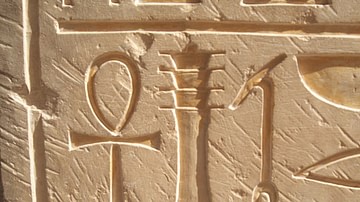
Ancient Egyptian Symbols
Religion in ancient Egypt was fully integrated into the people's daily lives. The gods were present at one's birth, throughout one's life, in the transition from earthly life to the eternal, and continued their care for...
