
Search
Did you mean: God?
Remove Ads
Advertisement
Search Results

Definition
Medea (Play)
The tragedy Medea was written in 431 BCE by Euripides (c. 484 – 407 BCE). Euripides authored at least 90 plays of which 19 have survived intact. As with the plays by Sophocles and Aeschylus, the audience was already well aware of...
Definition
Bellerophon
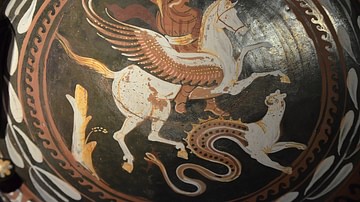
Bellerophon (aka Bellerophontes) is the Corinthian hero of Greek mythology who famously battled and killed the fantastical Chimera monster, a fearsome fire-breathing mix of lion, goat, and snake. Bellerophon was the son of Poseidon...

Definition
Pandora
Pandora is a figure from Greek mythology who was not only the first woman, but —as an instrument of the wrath of Zeus— was held responsible for releasing the ills of humanity into the world. Pandora was also an unrelated earth goddess...

Definition
Ninigi
Ninigi-no-Mikoto, or simply Ninigi, is the grandson of the supreme Shinto deity Amaterasu, the sun goddess. He is the son of Ama-no-Oshiho-mimi and, descending to earth as the first just ruler, he brought with him gifts from Amaterasu...

Definition
Hesperides
The Hesperides are nymph-goddesses of the evening and the west in Greek mythology. They were the daughters of Atlas, the Titan who bore the heavens on his shoulders, and Hesperis, the personification of the west, or Nyx, the personification...
Definition
Croesus
Croesus (r. 560-546 BCE) was the King of Lydia, a region in western Asia Minor (modern-day Turkey) and was so wealthy that the expression "as rich as Croesus" originates in reference to him. Best known for his wealth, he is also famous...

Definition
Hinduism
Hinduism is the oldest religion in the world, originating in Central Asia and the Indus Valley, still practiced in the present day. The term Hinduism is what is known as an exonym (a name given by others to a people, place, or concept...

Definition
Ancient Egyptian Mythology
Egyptian mythology was the belief structure and underlying form of ancient Egyptian culture from at least c. 4000 BCE (as evidenced by burial practices and tomb paintings) to 30 BCE with the death of Cleopatra VII, the...

Definition
New Kingdom of Egypt - The Age of Empire
The New Kingdom (circa 1570 to circa 1069 BCE) is the era in Egyptian history following the disunity of the Second Intermediate Period (circa 1782-1570 BCE) and preceding the dissolution of the central government...

Definition
Egyptian Obelisk
An obelisk is a stone rectangular pillar with a tapered top forming a pyramidion, set on a base, erected to commemorate an individual or event and honor the gods. The ancient Egyptians created the form at some point in the Early...
