
Search
Did you mean: God?
Remove Ads
Advertisement
Search Results

Definition
God
God' is the common word for the identity of a higher being in the universe beyond our world, the creator of all known existence, and who rules in conjunction with lower gradients of divinity (angels). In Greek, theikos ("divine") meant...

Definition
Heka
Heka is the god of magic and medicine in ancient Egypt and is also the personification of magic itself. He is probably the most important god in Egyptian mythology but is often overlooked because his presence was so pervasive as to make...

Definition
Sleipnir
Sleipnir is the eight-legged horse ridden primarily by the god Odin in Norse mythology. He is the son of the god Loki (in the form of a mare) and the stallion Svadilfari who belonged to the jötunn that built the walls of Asgard. In...

Article
Religion in Ancient China
Religious practices in ancient China go back over 7,000 years. Long before the philosophical and spiritual teachings of Confucius and Lao-Tzu developed or before the teachings of the Buddha came to China, the people worshipped...

Article
The Curse of Agade - Naram-Sin's Fictional Battle with the Gods
The Curse of Agade (also given as The Cursing of Agade) is a poem dated to the Ur III period of Mesopotamia (circa 2112 to circa 2004 BCE), though it is thought to be somewhat older in origin...

Article
The Myth of Etana - Faith and Kingship in Ancient Mesopotamia
The Myth of Etana is the story of the Sumerian antediluvian King of Kish who ascends to heaven on an eagle to request the Plant of Birth from the gods so that he might have a son. Etana is named...

Definition
Roman Religion
In many societies, ancient and modern, religion has performed a major role in their development, and the Roman Empire was no different. From the beginning Roman religion was polytheistic. From an initial array of gods and spirits...

Definition
Vikings
The Vikings were originally diverse Scandinavian seafarers from Norway, Sweden, and Denmark (though other nationalities were later involved) whose raids and subsequent settlements significantly impacted the cultures of Europe and were...

Article
The Legend of Cutha - A How-To on the Proper Relationship with One's God
The Legend of Cutha (also known as the Cuthean Legend of Naram-Sin, Cutha Legend, and Kutha Legend) is a fictional work dated to the 17th century BCE belonging to the genre known as...
Definition
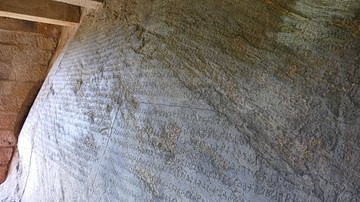
The Edicts of Ashoka the Great
The Edicts of Ashoka are 33 inscriptions engraved on pillars, large stones, and cave walls by Ashoka the Great (r. 268-232 BCE), the third king of the Mauryan Empire (322-185 BCE) of India. One set, the so-called Major...
