
Search
Did you mean: Gades?
Remove Ads
Advertisement
Search Results

Definition
Maya Civilization
The Maya are an indigenous people of Mexico and Central America who have continuously inhabited the lands comprising modern-day Yucatan, Quintana Roo, Campeche, Tabasco, and Chiapas in Mexico and southward through Guatemala...

Definition
Nabu - The Babylonian God of Wisdom and Writing
Nabu (sometimes known as Tutu) was the Babylonian god of wisdom, learning, prophecy, scribes, and writing, also responsible for the abundant harvest and all growing things. His name means "the Announcer,"...

Definition
Iphigenia in Aulis
Iphigenia in Aulis (or at Aulis) was written by Euripides, the youngest and most popular of the trilogy of great Greek tragedians. The play was based on the well-known myth surrounding the sacrifice of Agamemnon and Clytemnestra's...

Definition
Pasiphaë
Pasiphaë ("all-shining") is the wife of King Minos of Crete and the mother of the fearsome Minotaur (half-bull, half-man creature) in Greek mythology. She is the daughter of the sun god Helios and Perse, an Oceanid. Like her sister...

Video
Persephone, Queen of the Underworld
Learn all about the myth and legend of Persephone! Kelly Macquire tells the story of the goddess of grain and the queen of the underworld in Greek Mythology, Persephone. Persephone, also known as Kore or Proserpina...

Article
Beer in Ancient Egypt
Considering the value the ancient Egyptians placed on enjoying life, it is no surprise that they are known as the first civilization to perfect the art of brewing beer. The Egyptians were so well known as brewers, in fact...

Article
Winged Victory: the Nike of Samothrace
One of the most celebrated works of Hellenistic art is without doubt the Nike of Samothrace, on display at the Louvre since 1884 CE. The white Parian marble statue represents the personification of winged victory...
Article
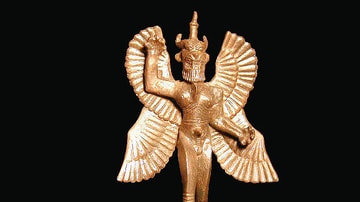
Twelve Menacing & Protective Mythological Figures
The term mythology comes from the Greek words mythos (“story of the people”) and logos (“word”) and so is defined as the spoken (later written) story of a culture. Modern scholars have divided myths...

Article
The Debate Between Sheep and Grain - A Sumerian Argument Between Animal Husbandry & Agriculture
The Debate Between Sheep and Grain (circa 2000 BCE) is one of the best-known Sumerian literary debates in a genre that was popular entertainment by the late 3rd millennium...

Article
The Ancient Concept of a Noble Death
The act of voluntary death was never condemned in antiquity. In fact, The English word "suicide" comes from the Latin for "self-slaying." The reason for a voluntary death had to be one that was honorable and necessary...
