
Search
Remove Ads
Advertisement
Search Results
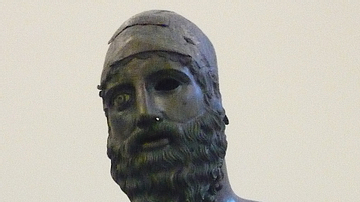
Image
Detail, Riace Warrior B
A detail of the bronze Greek sculpture Riace Warrior B, c. 460-450 BCE. One of a pair known as the Riace Bronzes which were rescued from the Ionian Sea near Riace Marina, Italy in 1972 CE. The bronze figure is 1.98 m (6.5...
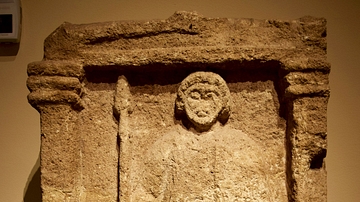
Image
Gravestone of a Warrior, Black Sea
A memorial carved from limestone of an ancient Black Sea warrior with his spear and shield. The Bosphorus region of present-day Turkey, c. 125-50 BCE. (Pushkin Museum, Moscow.)
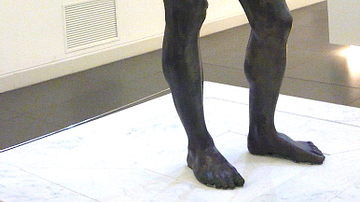
Image
Riace Warrior B
The bronze Greek sculpture Riace Warrior B, c. 460-450 BCE. One of a pair known as the Riace Bronzes which were rescued from the Ionian Sea near Riace Marina, Italy in 1972 CE. The bronze figure is 1.98 m (6.5 ft.) tall. (National...

Image
Pictish Warrior with Drinking Horn
Bearded Pictish warrior from the Bullion Stone, Angus, now in the National Museum of Scotland.
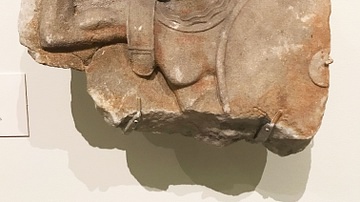
Image
Relief of a Greek Warrior
This relief of a Greek warrior dates from 600-50 BCE. It is made from marble. (Iris & B. Gerald Cantor Center for Visual Arts at Stanford University, Stanford, California)
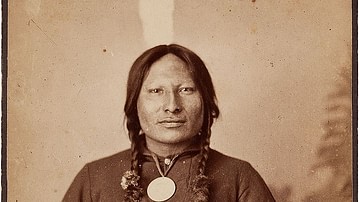
Image
Sioux Warrior Rain-in-the-Face
Sioux warrior Rain-in-the-Face, photographed by Orlando Scott Goff in 1874 while incarcerated at Fort Abraham Lincoln in Dakota Territory.

Image
Haniwa Warrior
A haniwa (tomb marker) in the form of a warrior wearing Keiko armour. Iizuko-cho, Ota-shi, Gunma, Japan. Kofun Period, 6th century CE. National Treasure. (Tokyo National Museum)

Image
Warrior Sekijin
A warrior sekijin or tomb marker. Iwatoyama Tumulus, Yoshida, Fukuoka, Japan. Kofun Period, 6th century CE. Important Cultural Property. (Tokyo National Museum).
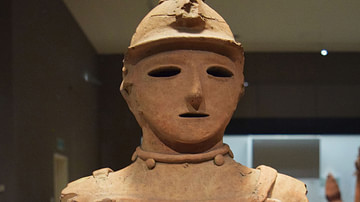
Image
Japanese Haniwa Warrior
This haniwa warrior in tanko armor is a terracotta tomb figurine. It comes from Kamichujo in Saitama prefecture, Japan. It dates from the 5th-6th century CE, during the Kofun period. Important cultural property. (Tokyo National...

Definition
Attila the Hun
Attila the Hun (r. 434-453 CE) was the leader of the ancient nomadic people known as the Huns and ruler of the Hunnic Empire, which he established. His name means "Little Father" and, according to some historians, may not have...
