
Search
Did you mean: Fates?
Remove Ads
Advertisement
Search Results

Article
Song of Everlasting Sorrow
The Song of Everlasting Sorrow is a narrative poem of the Tang Dynasty (618-907 CE) inspired by the love affair between Xuanzong (r. 712-756 CE), the seventh emperor of the dynasty, and his consort Lady Yang. It was written...

Image
Amphitheater at Augusta Raurica
In Roman times, the amphitheater in Augusta Raurica was a place of horror. Up to 13,000 spectators gathered here to watch gory entertainment, which included animal hunts, gladiatorial combat and executions. The amphitheater...

Image
Assyrian Army Assault on Lachish
Assyrian relief, from the South-West palace at Nineveh (modern Kuyunjik, Mousil city, Iraq), room XXXVI, panel 7, Neo-Assyrian Empire, 700-692 BCE. This wall relief delivers a very vivid description of the battlefield...
Image
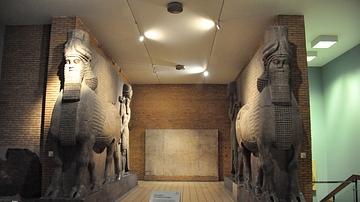
Human-Headed Winged Bulls and Genies from Khorsabad
A pair of human-headed and winged-bulls (lamassu), stood on either side of a gate at one of the citadel walls at Khorsabad. Two human-headed and winged protective spirits or genies stand behind the...

Image
The Porta Praetoria of Saalburg Roman Fort
The reconstructed Porta Praetoria, the main gate of the Saalburg Roman Fort. The gate takes its name from the Via Praetoria, the camp’s road running in a north-south direction. Between the two gates, a bronze...

Image
Headless Statue of Darius the Great
Headless, 2.5-metre tall (8.2 feet) granite statue of Darius I (r. 522-486 BCE) originally made to be set up in Egypt and found in 1972 in Susa on the west side of the Gate of Darius. Darius the Great is dressed...

Image
Hittite War Chariot
Relief orthostat (stone slab at base of wall) of war chariot from Sam'al (Turkey), west side of citadel gate; Basalt; Late Hittite period (9th cent BCE); Museum of the Ancient Orient, Istanbul Archaeological Museums.

Image
Marble Door at Hagia Sophia
White marble door of the Hagia Sophia, photograph by Juan Ángel Piqueras, Istanbul, 25 February, 2026. The Marble Door (also known as “Gate of Heaven and Hell”) in Hagia Sophia’s south upper gallery marks the threshold...

Image
The East India House Inscription
Building Babylon: this inscribed stone was found at the ruins of Babylon and described the religious devotion and civic achievement of king Nebuchadnezzar II. The long inscription records that as well as building...
Image
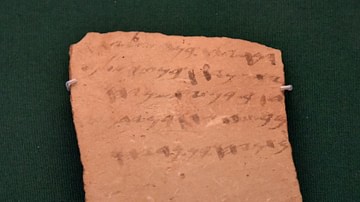
Lachish Letter I
This is Lachish Letter I, a pottery ostracon with Hebrew inscription. This ostracon is probably a fragment of a wheel-made storage jar. The so-called "Lachish Letters" are documents consisting of potsherds inscribed in black...
