
Search
Remove Ads
Advertisement
Search Results

Definition
Seleucid Empire
The Seleucid Empire (312-63 BCE) was the vast political entity established by Seleucus I Nicator ("Victor" or "Unconquered", l. c. 358-281 BCE, r. 305-281 BCE), one of the generals of Alexander the Great who claimed a part of...

Article
Liangzhu Culture Jade
Jade artifacts and icons are almost synonymous with the Chinese culture going back thousands of years. Jade (nephrite) was first worked into recognizable objects c. 6000 BCE during the period of the Houli Culture (c. 6500...

Interview
Interview: Buddhism in Korea
In this interview, James Blake Wiener, Co-Founder and Communications Director at Ancient History Encyclopedia (AHE), speaks to Emeritus Professor James H. Grayson, Professor of Korean Studies at the University of Sheffield...
Image
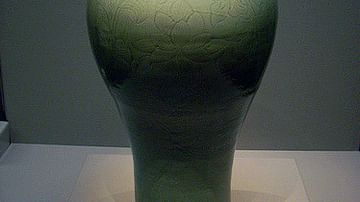
Maebyeong Celadon Vase, Goryeo Dynasty
A maebyeong celadon vase with lotus decoration. 12th century CE, Goryeo Dynasty, Korea. (National Museum of Korea, Seoul, South Korea)

Image
Bronze Korean Coin, Goryeo Dynasty
A bronze coin of the Korean Goryeo Dynasty, 1097-1105.
The legend reads: Haedong tongbo meaning 'Coin of the Land East of the Sea' (Korea).
The British Musem, London.

Image
Ming Dynasty Blue-and-White Porcelain
A selection of Ming Dynasty (1368-1644 CE) blue-and-white porcelain. From Chenghua reign, 1465-1487 CE. (British Museum, London)
Image
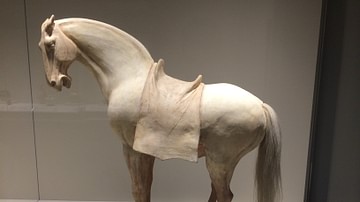
Tang Dynasty Horse
A unglazed ceramic horse from the Tang Dynasty. China, 8th century CE. (St. Louis Art Museum, Missouri)
Image
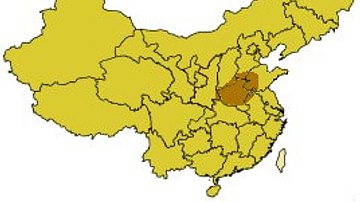
Xia Dynasty
A map of China indicating the territory controlled by the Xia Dynasty (c. 2070-1600 BCE).
Image
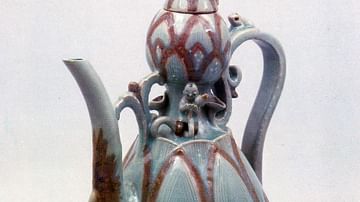
Celadon Ewer, Goryeo Dynasty
A celadon gourd-shaped ewer deocrated with lotus petals. 13th century CE, Goryeo Dynasty, Korea. (Leeum, Samsung Museum of Art, Seoul, South Korea)
Image
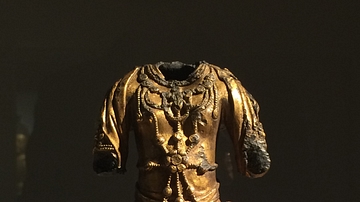
Goryeo Dynasty Bodhisattva
Gilt bronze bodhisattva seated on a lotus leaf. Goryeo Dynasty, 13th century CE. (Musée Guimet, Paris)
