
Search
Remove Ads
Advertisement
Search Results

Definition
Synod of Whitby
The Synod of Whitby was an assembly held in 664 by King Oswiu of Northumbria, with the aim of deciding whether Oswiu's kingdom should follow Roman Christian customs or those of the Irish Christians at Iona, particularly regarding...
Definition
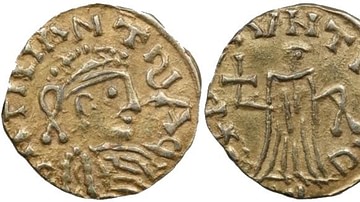
Guntram I of Orléans
Guntram I (also given as Gontrand, Gunthram, or Gunthchramn) was a Merovingian king who ruled over the Frankish kingdom of Orléans, later referred to as Burgundy, from 561 to 592. He often took on the role of mediator in the...

Definition
Ancient Egyptian Government
The government of ancient Egypt was a theocratic monarchy as the king ruled by a mandate from the gods, initially was seen as an intermediary between human beings and the divine, and was supposed to represent the gods'...

Definition
Aethelstan
Aethelstan was the first King of England, ruling from 927 to 939. The son of Edward the Elder (reign 899-924) and grandson of Alfred the Great (reign 871-899), he inherited the southern-based Kingdom of the Anglo-Saxons in 924 before...
Definition
Pontius Pilate
Pontius Pilate was the fifth magistrate to serve in the Roman province of Judea, created in 6 CE by Roman emperor Augustus (r. 27 BCE to 14 CE). His term of office was during the subsequent reign of Tiberius from 26-36 CE. He became...

Definition
Moroccan Crises - German v. French Imperialism
The Moroccan Crises were two international incidents, the first in 1905-6 and the second in 1911, when Imperial Germany, eager to expand its empire, threatened France's presence in Morocco. France's position...

Article
Charles A. Eastman on Crazy Horse
Charles A. Eastman's biography of Crazy Horse (l. c. 1840-1877) is among the most significant sources on the great Sioux war chief, as Eastman drew on accounts of those who had known and fought alongside him in writing...

Article
The Boy Who Was Sacrificed
The Boy Who Was Sacrificed is a legend of the Pawnee nation highlighting the belief that everything happens for a reason according to the will of Ti-ra'wa ("Father Above"), the supreme creator, and how even the smallest...

Definition
Critias
Critias (l. c. 460-403 BCE) was an Athenian politician, poet, and playwright, one of Socrates' followers, Plato's second cousin, a leading member of the Thirty Tyrants of Athens, and leader of the oligarchy they established. He is referenced...

Definition
Robert the Bruce
Robert I of Scotland, better known as Robert the Bruce, reigned as King of Scotland from 1306 to 1329 CE. For his role in achieving independence from England, Robert the Bruce has long been regarded as a national hero and one...
