
Search
Remove Ads
Advertisement
Search Results

Definition
Martin Luther
Martin Luther (l. 1483-1546) was a German priest, monk, and theologian who became the central figure of the religious and cultural movement known as the Protestant Reformation. Even though earlier reformers had expressed Luther's...
Definition
Hitler Youth
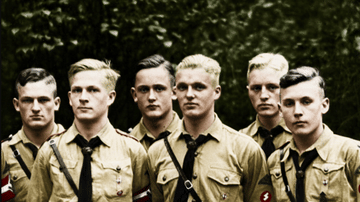
The Hitler Youth (Hitlerjugend or HJ), named after the leader of the German Nazi Party Adolf Hitler (1889-1945), was designed to indoctrinate 14-18 year-old boys into the party's way of thinking. Its activities promoted physical...

Definition
Night of the Long Knives
The Night of the Long Knives (aka Blood Purge or Röhm-Putsch) of 30 June 1934 was a purge of the Nazi Sturmabteilung (SA) paramilitary group which continued through 1 and 2 July. Adolf Hitler (1889-1945), wary of the growing...

Definition
Franz Schubert
Franz Schubert (1797-1828) was an Austrian composer of Romantic music best known for his songs, symphonies, piano music, and chamber music. Schubert's career lasted only 15 years, but he was a prolific composer. Neither a conductor...

Definition
Richard Strauss
Richard Strauss (1864-1949) was a German conductor and composer of both innovative late-Romantic and Modernist music. He is best known for his symphonic poems and operas like Salome and Elektra, both of which caused a sensation...

Definition
Martin Bucer
Martin Bucer (l. 1491-1551) was a German reformer and theologian who had been a Dominican friar and priest until converted to the Protestant vision by Martin Luther (l. 1483-1546) c. 1518. Bucer is best known for his focus on unity...

Definition
Pink and White Terraces of New Zealand
The cascading geothermal pink and white terraces of Aotearoa New Zealand were often referred to internationally and within New Zealand as the eighth wonder of the world. They were a famous tourist attraction...

Article
Battle of Waterloo
The Battle of Waterloo (18 June 1815) was the last major engagement of the Napoleonic Wars (1803-1815), fought by a French army under Emperor Napoleon I (r. 1804-1814; 1815) against two armies of the Seventh Coalition. Waterloo...

Article
5 Top Aces of World War I - The Fighter Pilots Who Became National Heroes
WWI saw the birth of an entirely new form of combat: lone men engaging the enemy in aerial dogfights. The victors became heroes back home, but this was as deadly an occupation as it...

Article
The Causes of WWI
The origins of the First World War (1914-18) are many and varied, with some even dating back several decades, but a political assassination in the Balkans in the summer of 1914 was the spark that blew up Europe's political powder...
