
Search
Remove Ads
Advertisement
Search Results

Definition
Titus (Roman Emperor)
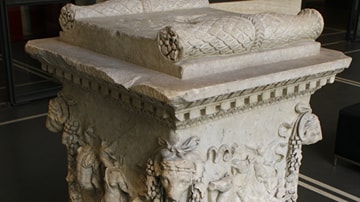
Titus was Roman emperor from 79 to 81 CE. On June 24, 79 CE Titus Flavius Vespasianus succeeded his father Vespasian (r. 69-79 CE) as emperor of the Roman Empire. Prior to his ascension to the throne, he was considered by...
Definition
Roman Religion
In many societies, ancient and modern, religion has performed a major role in their development, and the Roman Empire was no different. From the beginning Roman religion was polytheistic. From an initial array of gods and spirits...

Definition
Mencius
Mencius (l. 372-289 BCE, also known as Mang-Tze or Mang-Tzu) was a Confucian philosopher during The Warring States Period in China (c. 481-221 BCE) and is considered the greatest after Confucius himself for his interpretation, formulation...

Definition
Goguryeo
Goguryeo (Koguryo) was a kingdom which ruled northern Korea during the Three Kingdoms period from the 1st century BCE to 7th century CE. The kingdom flourished in the 5th and 6th century CE and has left a rich cultural heritage best...

Definition
Greek Architecture
Greek architecture is concerned with simplicity, proportion, perspective, and harmony in buildings. Greek architecture includes some of the finest and most distinctive buildings ever built. Examples of Greek architecture include...

Definition
Upanishads
The Upanishads are the philosophical-religious texts of Hinduism (also known as Sanatan Dharma meaning “Eternal Order” or “Eternal Path”) which develop and explain the fundamental tenets of the religion. The name is translated as...

Definition
Pisistratus - Tyrant of Ancient Athens
Pisistratus (circa 600-527 BCE), or Peisistratus, was an ancient Greek tyrant who ruled the city-state of Athens. Initially a student of the lawgiver and political philosopher Solon, Pisistratus presented himself...

Definition
Roman Mythology
The ancient Romans had a rich mythology and, while much of it was derived from their neighbors and predecessors, the Greeks, it still defined the rich history of the Roman people as they eventually grew into an empire. Roman writers...
Definition
Aztec Warfare
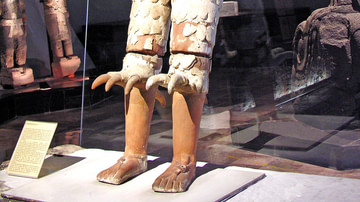
The Aztecs engaged in warfare (yaoyotl) to acquire territory, resources, quash rebellions, and to collect sacrificial victims to honour their gods. Warfare was a fundamental part of Aztec culture with all males expected to actively...

Definition
Ninhursag - The Original Mother Earth
Ninhursag (also Ninhursaga) is the Sumerian mother goddess and one of the oldest and most important in the Mesopotamian pantheon. She is known as the Mother of the Gods and Mother of Men for her part in creating...
