
Search
Did you mean: Empire?
Remove Ads
Advertisement
Search Results
Definition
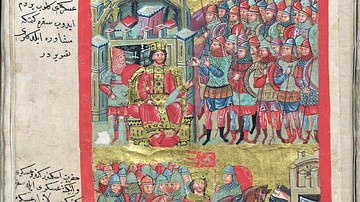
Empire of Trebizond
The Empire of Trebizond was an offshoot of the Byzantine Empire that existed from 1204 to 1461 CE, ruled by the Megas Komnenos Dynasty, descendants of the Komnenos Byzantine emperors. The Empire of Trebizond has been far less...

Definition
Arsacid Dynasty of Armenia
The Arsacid (Arshakuni) dynasty of Armenia ruled that kingdom from 12 CE to 428 CE. A branch of the Arsacid dynasty of Parthia, the Armenian princes also played out a prolonged balancing act by remaining friendly to the...

Definition
Mamikonian Dynasty
The Mamikonians were a powerful clan group who were influential in Armenian political and military affairs from the 1st century BCE onwards. They rose to particular prominence from c. 428 CE to 652 CE in the half of Armenia...

Definition
Battle of Immae
The Battle of Immae (272 CE) was fought between the forces of the Roman emperor Aurelian (270-275 CE) and those of the Palmyrene Empire of Zenobia (267-273 CE) resulting in a Roman victory and, ultimately, the capture of Zenobia...

Definition
Sir William Johnson
Sir William Johnson, 1st Baronet (l. c.1715-1774) was a British military officer, diplomat, and Superintendent of Indian Affairs. He was instrumental in aligning the Native Americans of New York with the British during the...
Definition
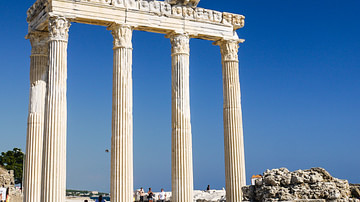
Side
Side (pronounced see-day) was a city on the southern coast of Cilicia (modern-day Turkey) first settled in the 7th century BCE by immigrants from Cyme, an Aeolian municipality to the north near the kingdom of Lydia. Its name means 'pomegranate'...

Article
Agriculture in the Fertile Crescent & Mesopotamia
The ancient Near East, and the historical region of the Fertile Crescent in particular, is generally seen as the birthplace of agriculture. The first agricultural evidence comes from the Levant, from...

Image
The Columbian Exchange - Global Connections and Consequences after 1492
The Columbian Exchange (from 1492 CE) refers to the large-scale transfer of plants, animals, diseases, peoples, and technologies between the Americas and Afro-Eurasia following the transatlantic...

Image
Map of the Holy Roman Empire under Otto the Great c. 972 - The Formation of Imperial Rule in Medieval Europe
The Holy Roman Empire emerged from the fragmentation of the Carolingian world during the 9th and 10th centuries, as the eastern Frankish kingdom developed...

Image
Map of the Middle Kingdom Egypt (c. 2050–1800 BCE) - Reunification, Nubian Frontiers & Trade Networks
The Middle Kingdom of Egypt (c. 2050–1650 BCE) was a period of political reunification, renewed royal authority, and cultural achievement following the fragmentation...
