
Search
Remove Ads
Advertisement
Search Results

Image
Emperor Taizong
A painted silk scroll depicting Taizong, second emperor during the Tang Dynasty of China, r. 626-649. The emperor's robe shows a dragon, a traditional symbol of rulership as the creature represents wisdom, justice, and benevolence. National...
Image
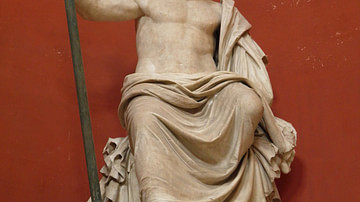
Roman Emperor Galba
Statue of an emperor, heavily restored by Bartolomeo Cavaceppi as a portrait of emperor Galba. (Sala Rotonda Museo Pio-Clementino, Vatican Museums)

Image
Leopold I, Holy Roman Emperor, As a Young Man
Portrait of Emperor Leopold I as a young man, wearing the Order of the Golden Fleece, oil on canvas by Benjamin Block, 1631-1689. Private collection. This portrait of the young monarch is rare as it depicts Leopold I, Holy Roman Emperor...

Image
Proclaiming Claudius Emperor
Proclaiming Claudius Emperor, oil on panel painting by Lawrence Alma-Tadema, 1867.
Depicted here is Claudius being proclaimed emperor by the Praetorian Guard following the assassination of Caligula.

Image
Portrait of Emperor Guangxu
A portrait of Emperor Guangxu (r. 1875-1908), the 10th emperor of the Chinese Qing dynasty.
Image
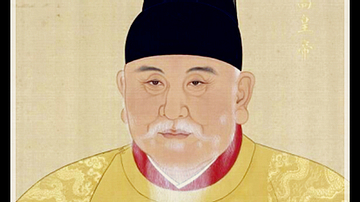
Ming Taizu, aka Hongwu Emperor
The Hongwu Emperor, the first emperor of the Ming Dynasty (1368 to 1644 CE) who reigned from 1368 to 1398 CE. 14th century CE painted silk hanging.
Image
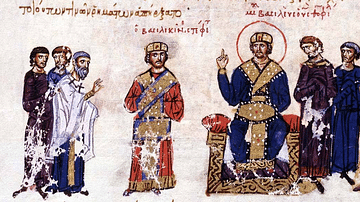
Michael III Crowns Basil Co-emperor
A 13th century CE illustration showing Byzantine emperor Michael III (r. 842-867 CE) crowning his great friend and political ally Basil the Macedonian co-emperor. The latter would take the crown himself in 867 CE as Basil I. (Madrid Sklitzes...

Definition
Carolingian Dynasty
The Carolingian Dynasty (751-887) was a family of Frankish nobles who ruled Francia and its successor kingdoms in Western and Central Europe during the Early Middle Ages. The dynasty expanded from Francia as far as modern Italy, Spain, and...

Definition
Livia Drusilla
Livia Drusilla (58 BCE - 29 CE) was the third wife of emperor Augustus of Rome, mother of emperor Tiberius, and grandmother of emperor Claudius. She was one of the great women in history who achieved prominence living in the shadow of a strong...

Definition
Agrippina the Younger
Julia Agrippina or Agrippina the Younger (6 November 15 - 19/23 March 59 CE) was a prominent woman during the early Roman Empire, niece to Tiberius (r. 14-37 CE) and Claudius (41-54 CE), whom she married, sister of Caligula (r. 37-41 CE...
