
Search
Remove Ads
Advertisement
Search Results
Image
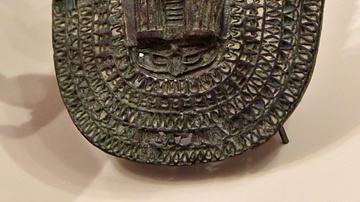
Egyptian Aegis
Egyptian aegis with the head of the goddess Hathor. Her headdress is composed of uraei (rearing cobras) beneath a sun-disc and cow's horns. Bronze. From Egypt, precise provenance is unknown. Third Intermediate Period, 26th Dynasty...

Image
Egyptian Governor Hori
Seated figure of the Egyptian governor Hori with an inscription of a prayer to the god Ptah-Soker-Osiris. Basalt. Middle Kingdom, 13th Dynasty, 1750-1700 BCE. From Egypt, precise provenance unknown. It is on display at the...

Image
Ancient Egyptian Gazelle Mummy
This gazelle mummy dates from the Late Period (664-332 BCE) of ancient Egyptian history. Its exact provenance is unknown. (Royal Ontario Museum, Toronto)

Image
Nimrud Ivory Plaque of an Egyptian Sphinx
A winged human-headed sphinx wears the double crown of Egypt. An apron hangs down on the chest with a projecting uraeus (rearing cobra) similar to those worn by Egyptian pharaohs. A striking Phoenician style...
Image
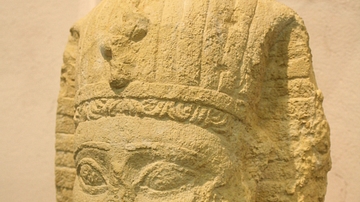
Egyptian Sphinx Head
Limestone sphinx head from the Ptolemaic period, Medinet Madi, Temple of Isis-Thermutis. (Egyptian Museum, Castello Sforzesco, Milan)

Image
Statuette of Egyptian Governor Khnumnakht
Made from limestone, this statuette shows the ancient Egyptian governor Khnumnakht. He was a contemporary of Djehutihotep—the fifteenth nomos of Upper Egypt— who lived during the twelfth dynasty (c. 1985-1773...
Image
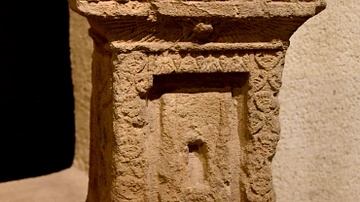
Egyptian-Type Votive Altar from Sidon
This marble votive stele has an Egyptian style (note the row of uraeus cobras at the top). First half of the 5th century BCE. From Sidon, in modern-day Lebanon. (Museum of Archaeology, Istanbul, Turkey).
Image
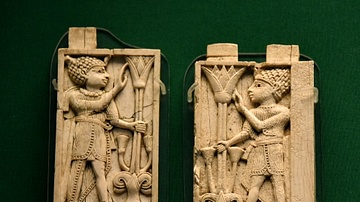
Nimrud Ivory Panels of Two Egyptian Kings
Two panels from a much larger composition, each showing a youth dressed in Egyptian royal costume grasping a tree formed by a lotus flower arising from a double volute. On the front of the lower right-hand...
Image
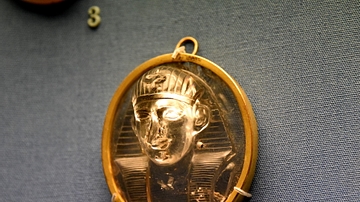
Cameo of an Egyptian King
This rock-crystal cameo depicts a king in an Egyptian style; popular in Italy, where it was probably made. Roman period, 1st century CE. (The British Museum, London).

Image
Egyptian Painting of Syrian Bears
This painted limestone fragment came from the mortuary temple of the Egyptian Pharaoh Sahure at Abusir, Egypt. It depicts Syrian bears and a vessel (possibly tributary). Old Kingdom, 5th Dynasty, 2496-2483 BCE. On...
