
Search
Remove Ads
Advertisement
Search Results

Definition
God's Wife of Amun
The position of God's Wife of Amun was one of the most politically powerful and spiritually significant in later Egyptian history. Elevated from a figurehead in the New Kingdom (c.1570-1069 BCE), the God's Wife of Amun would...

Video
Greek Sculpture - Ancient History Encyclopedia
Greek sculpture from 800 to 300 BCE took early inspiration from Egyptian and Near Eastern monumental art, and over centuries evolved into a uniquely Greek vision of the art form. Greek artists would reach...

Article
The Mummy's Curse: Tutankhamun's Tomb & the Modern-Day Media
Howard Carter's 1922 CE discovery of the tomb of Tutankhamun was world-wide news but, following fast upon it, the story of the mummy's curse (also known as The Curse of the Pharaoh) became even...

Article
Trade in Ancient Egypt
Trade has always been a vital aspect of any civilization whether at the local or international level. However many goods one has, whether as an individual, a community, or a country, there will always be something one lacks...

Definition
Akhenaten
Akhenaten (r. 1353-1336 BCE) was a pharaoh of 18th Dynasty of the New Kingdom of Egypt. He is also known as 'Akhenaton' or 'Ikhnaton' and also 'Khuenaten', all of which are translated to mean 'successful for' or 'of great use to' the...

Definition
Arsinoë IV
Arsinoë IV (d. 41 BCE) was a Ptolemaic princess who rebelled against her sister Cleopatra VII during the Alexandrian War in 48 BCE. After being defeated by Cleopatra's ally Julius Caesar, she was a captive in his Roman triumph. Arsinoë...

Image
Egyptian stela from Intef blocks at a temple precinct
On this fragment of a limestone stela, a man sits, facing to the right; behind him, a trace of a women appears. The hieroglyphs mention a reference to an acquisition of three different kinds of animals...
Image
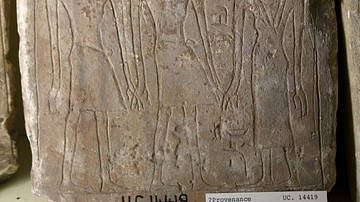
Egyptian Stela of Neferhotep
On this limestone stela, the hieroglyphic inscriptions mention the name of the Overseer of Cattle Neferhotep, son of the Overseer of Cattle Dednub and the chantress Itires. On the lower right border, a standing woman...

Image
Egyptian Anthropomorphic Pot
This is a redware pot. It depicts a woman with breasts and arms; she holds a spout (which is lost). There is a hole at the back of the pot for filling. From Egypt. Middle Kingdom, 2061 to 1690 BCE. The Petrie Museum...

Image
Egyptian Limestone Fragment with Kheker Frieze
Limestone block carved with a kheker frieze at the upper part, from Kopotos (Qift), Egypt, 1580-1550 BCE. At the lower middle part, we can see the the double plume headdress of the god Min; on its either...
