
Search
Remove Ads
Advertisement
Search Results
Definition
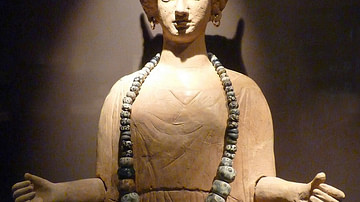
Carthaginian Religion
Carthage was founded by the Phoenician city of Tyre in the 9th century BCE, and along with many other cultural practices, the city adopted aspects of the religion of its founding fathers. Polytheistic in nature, such important...

Definition
Tenjin
Sugawara no Michizane, aka Tenman Tenjin (845-903), was a scholar, poet, and high-level administrator in the Japanese court during the Heian Period. Badly treated and exiled, he would gain a spectacular revenge on his political rivals...

Definition
John the Baptist
John the Baptist (d. c. 30 CE) was a 1st-century CE itinerant preacher in Judea. We do not know his full name, but he is recognized by his activity. 'Baptizer' (Greek: baptizo) was translated directly into English and meant 'to...

Definition
Sejong the Great
King Sejong the Great (15 May 1397 to 8 April 1450 CE) ruled Korea from 1418 to 1450 CE as the fourth king of the Joseon Dynasty (also spelled Choson). One of only two Korean kings called 'the Great' today, Sejong had a major...

Definition
Yuan Dynasty
The Yuan Dynasty was established by the Mongols and ruled China from 1271 to 1368. Their first emperor was Kublai Khan (r. 1260-1294) who finally defeated the Song Dynasty which had reigned in China since 960. Stability and peace...

Definition
Elizabeth I of England
Elizabeth I reigned as queen of England from 1558 to 1603. Her 44-year reign was so long and packed with momentous events that the second half of the 16th century is now known as the Elizabethan era and still regarded as...

Definition
Early Joseon Period
The Early Joseon Period (1392 - c. 1550 CE) in Korea was bookended by internal power struggles but witnessed major scientific and societal advances and prosperity. The Joseon (Choson) Dynasty ruled Korea from 1392 CE to 1897...

Definition
Estates-General of 1789
The Estates-General of 1789 was a meeting of the three estates of pre-revolutionary France: clergy, nobility, and commons. Summoned by King Louis XVI of France (r. 1774-1792) to deal with financial and societal crises, it...

Definition
Council of Trent
The Council of Trent (1545-1563) was a meeting of Catholic clerics convened by Pope Paul III (served 1534-1549) in response to the Protestant Reformation. In three separate sessions, the council reaffirmed the authority of the...

Definition
Civil Constitution of the Clergy
The Civil Constitution of the Clergy was a law passed in July 1790 during the French Revolution (1789-1799), which caused the immediate subordination of the Catholic Church in France to the French government. An attempt...
