
Search
Remove Ads
Advertisement
Search Results
Image
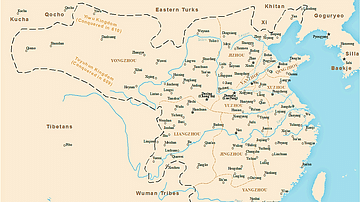
Sui Dynasty Map
The Territory of China's Sui Dynasty (589-618 CE).

Image
Jurchen Jin Dynasty Vase
A green glazed vase with floral design, Jurchen Jin dynasty, 1115-1234 CE. (British Museum, London)

Definition
Ancient Jordan
Jordan is a country in the Near East bordered by Israel, Syria, Iraq, and Saudi Arabia. The country's name comes from the Arabic Al Urdun, referencing a fortified site but also meaning "prominence", though various sources also...

Definition
Möngke Khan
Mongke Khan was ruler of the Mongol Empire (1206-1368 CE) from 1251 to 1259 CE. As the third Great Khan or 'universal ruler' of the Mongols, Mongke would oversee administrative reforms that continued to centralise government and ensure...

Definition
White Huns (Hephthalites)
The White Huns were a race of largely nomadic peoples who were a part of the Hunnic tribes of Central Asia. They ruled over an expansive area stretching from the Central Asian lands all the way to the Western Indian Subcontinent...

Definition
Taxila
When it comes to ancient history, Pakistan contains its fair share of treasures, one of the prominent of these being the ancient metropolis of Taxila. It is a city of the Gandharan civilization, sometimes known as one of its capitals...

Definition
Harsha
Emperor Harshavardhana, better known as Harsha, lived from 590 to 647 CE and was the last ruler of the Vardhana Empire, the last great empire in ancient India before the Islamic Invasion. He ruled from 606 CE to 647 CE. After Harshavardhana's...

Definition
First Fitna
The First Fitna (656-661 CE) was the first civil war of the Islamic Empire fought between the fourth Rashidun Caliph, Ali ibn Abi Talib (656-661 CE), and the governor of Syria, Muawiya (later Muawiya I; r. 661-680 CE). Deep fissures...

Definition
Charles V, Holy Roman Emperor
Charles V, Holy Roman Emperor (24 February 1500 to 21 September 1558) reigned from 1519 until his abdication in 1556 and was one of the most powerful rulers in the history of the Habsburg dynasty. Through a series of...

Definition
Three Kingdoms Period in Korea
The Three Kingdoms Period of ancient Korea (57 BCE – 668 CE) is so-called because it was dominated by the three kingdoms of Baekje (Paekche), Goguryeo (Koguryo), and Silla. There was also, though, a fourth entity...
