
Search
Remove Ads
Advertisement
Search Results
Image
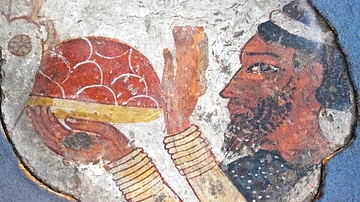
Fragment of a Near Eastern Man
This painted fragment on stone shows a foreign man from the Near East or Canaan presenting fruit. It was painted in ancient Egypt c. 1340 BCE. (Musée du Cinquantenaire, Brussels)

Image
Europe after The Treaty of Versailles
This map illustrates the situation in Europe in November 1920 in the aftermath of First World War (1914-18), as the continent was reshaped by the Treaty of Versailles (1919) and the Treaty of Sèvres (1920). The German Empire had collapsed...

Article
The Spice Trade & the Age of Exploration
One of the major motivating factors in the European Age of Exploration was the search for direct access to the highly lucrative Eastern spice trade. In the 15th century, spices came to Europe via the Middle East land and sea routes, and spices...

Image
Prominent Cities of Europe from Antiquity to the Present
A map of Europe displaying important cities that shaped its history, from antiquity to the present. Cities on the map represent key centers throughout history. Each city represents a distinct period from Athens, Rome, and Constantinople (now...

Image
Map of Europe after the Congress of Berlin, 1878 - From Italian and German Unification to Balkan Crisis
The mid-19th century transformation of Europe was driven above all by the unification of Italy and Germany, which reduced long-standing political fragmentation and introduced powerful new nation-states into an already competitive continental...

Image
Map of Elizabethan Trade with Europe, c. 1600 - Trade and Diplomacy in the Tudor World
During the reign of Queen Elizabeth I (reign 1558–1603), England underwent a decisive commercial transformation, expanding its trade networks across northern and southern Europe at a moment of shifting geopolitical and economic balance. The...

Definition
Batu Khan
Batu Khan (l. 1205-1255 CE) was a grandson of Genghis Khan and the founder of the Golden Horde. Batu was a skilled Mongol military commander and won battles from China to Persia, although his most famous exploits involve the grand Mongol...

Image
The Feudal Society in Medieval Europe - Power in Medieval Europe: Lords, Land & the Church
The social structure of medieval Western Europe (c. 10th–13th centuries) is often described through the framework of feudal relationships and landholding systems that linked rulers, nobles, and rural communities. In this model, political...

Image
Totalitarian Regimes in Europe in 1939
This map illustrates the geopolitical situation in Europe in the lead-up to the Second World War (1939-45) as authoritarianism and totalitarianism were on the rise across the continent, fueled by political instability, economic crises, and...

Image
Map of the Holocaust in Europe during World War II
During World War II (1939-1945), Nazi Germany under Adolf Hitler (rule 1933-1945) carried out the Holocaust, a systematic, state-directed genocide that resulted in the murder of approximately six million Jews, alongside millions of other...
