
Search
Remove Ads
Advertisement
Search Results

Image
Eastern Terrace of Mount Nemrut
Overview of the thrones and the heads of the gods on the eastern terrace of Mount Nemrut. From left to right: King Antiochus I, Commagene-Fortuna, Zeus-Oromasdes, Apollo-Mithras and Hercules. Mount Nemrut (Turkish...

Image
Map of the Hadrian’s Second Eastern Tour, 128–133 CE - Greek Culture, Eastern Diplomacy and the Crisis in Judaea
Hadrian’s second eastern tour (128–133 CE) was the longest and most complex journey of his reign, combining cultural patronage, diplomacy, provincial...

Definition
Siege of Tobruk
The siege of the port of Tobruk in Libya (April to Dec 1941) by Axis forces during the Second World War (1939-45) lasted 242 days and became a symbol of Allied resistance. Besieged by land but still supplied by sea, Tobruk was...

Image
Eastern Gate of Philippopolis
Eastern Gate of Philippopolis, photograph by Carole Raddato, Bulgaria, 10 August, 2024. The monumental eastern entrance to Roman Philippopolis (modern Plovdiv), Bulgaria. A broad paved street led from the gate into...
Image
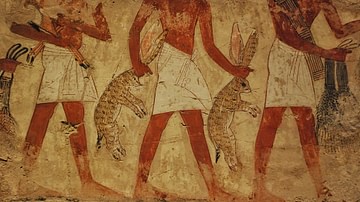
Egyptian Desert Hare Hunting
An Egyptian servant is carrying two desert hares as an offering to Nebamun, a rich Egyptian accountant. Detail of a larger procession of agricultural offerings, from the tomb of Nebamun (c. 1350 BCE). The British Museum...

Image
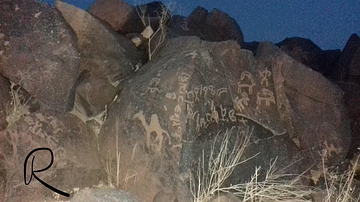
Desert Drawing and Safaitic Inscription
Safaitic inscription with an image of a Bactrian camel carved on a desert rock. The detailed drawing indicates that the scribe has seen this type of Asian camel, probably along the trade route with China. First...
Image
Safaitic Inscriptions in the Jordan Desert
Safaitic inscriptions on basalt rocks. 1st century BCE to 4th century CE. Jordan Desert or Al Harr’a.
Image
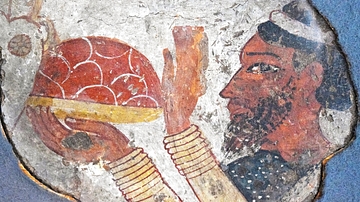
Fragment of a Near Eastern Man
This painted fragment on stone shows a foreign man from the Near East or Canaan presenting fruit. It was painted in ancient Egypt c. 1340 BCE. (Musée du Cinquantenaire, Brussels)

Image
Byzantine Floor Mosaic from Eastern Mediterranean
This exceptional mosaic likely comes from the floor of a house or public building. It reflects the Late Romand and Early Byzantine taste for intricate and colorful designs. It dates from c. 325-350 CE...
Image
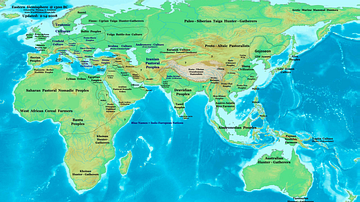
Eastern Hemisphere in 1300 BC
It shows ancient Africa, Asia, Europe, Oceania in 1300 BC.
