
Search
Remove Ads
Advertisement
Search Results

Image
East Asian Silver Bars
East Asian silver bars of 1, 10, 30 and 100 lang.
Musée de la Monnaie de Paris.

Image
Map of the East India Company's Rise to Power, c. 1765 - Robert Clive and the Making of Company Power in India
The British East India Company's (EIC) rise to power in India accelerated between 1757 and 1765 as a commercial corporation increasingly acquired military...

Definition
Bartolomé de Las Casas
Bartolomé de Las Casas (1484-1566) was a Spanish Dominican friar and former conquistador who revealed the atrocities of the conquests of New Spain and Peru and who strove to protect the basic rights of indigenous peoples...

Definition
Boston Tea Party
The Boston Tea Party was an act of political protest carried out by American colonists on 16 December 1773, in Boston, Massachusetts. Disguised as Mohawk Native Americans, the colonists dumped 342 crates of tea into Boston Harbor...

Image
Map of the ancient Near East during the Amarna Period
Map of the ancient Near East during the Amarna Period, showing the great powers of the period: Egypt (green), Hatti (yellow), the Kassite kingdom of Babylon (purple), Assyria (grey), and Mittani (red...

Image
East India Company Madras Uniforms
A c. 1830 illustration by Yellapah of Vellore showing six Sepoy uniforms of the East India Company Madras army. From left to right: - Madras Horse Artillery - Madras Light Cavalry - Madras Rifle Corps -...
Image
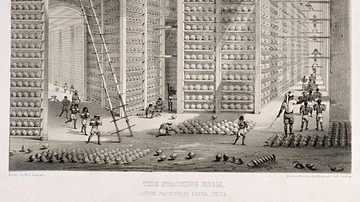
Opium Warehouse of the East India Company
A c. 1850 print showing an opium warehouse of the East India Company in Patna, India. Opium was dried into large balls and then packed into chests for transportation to China.

Image
East India Company Trooper & Sepoy
An 1839 illustration showing a trooper and sepoy (Indian recruit) of the East India Company army. 27th Regiment of Madras Native Infantry. (British Library, London)

Image
Dutch East India Company's Warehouse and Living Quarters
Dutch East India Company's warehouse and living quarters in Surat, India, as seen in April 1629 by Pieter van den Broecke (1585-1640), a Dutch cloth merchant in the service of the VOC.
Image
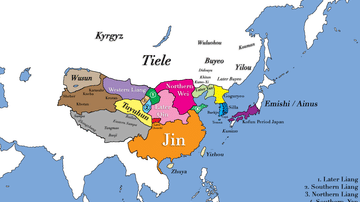
East Asia in 400 CE
This map shows all major civilizations of East Asia at the beginning of 4th century CE. Italicized texts indicate nomadic bands or tribal societies.
