
Search
Remove Ads
Advertisement
Search Results

Image
Viceroyalty of New Spain, c. 1800
This map illustrates the Viceroyalty of New Spain, the earliest and most extensive administrative division of the Spanish Empire. At its peak, it encompassed a vast array of territories across North America, the...

Article
The Siege of Acre, 1291 CE
The Siege of Acre in 1291 CE was the final fatal blow to Christian Crusader ambitions in the Holy Land. Acre had always been the most important Christian-held port in the Levant, but when it finally fell on 18 May 1291...

Definition
Persis
Persis (in Greek, derived from Persian pars) is the ancient name of the approximate area of modern Fars in Central Iran, as well as a state of the Hellenistic and Imperial periods in this same province. Its name is derived from the Persians...

Definition
Horyuji
The Horyuji Temple near Nara in Japan was founded in 607 CE by Prince Shotoku and is the only surviving Buddhist monastery from the Asuka Period in its original state. The complex, consisting of 48 listed buildings including a 5-storey...

Definition
Ming Dynasty
The imperial Ming dynasty ruled China from 1368 to 1644. It replaced the Mongol Yuan dynasty which had been in power since the 13th century. Despite challenges from abroad and within, the Ming dynasty oversaw an unprecedented growth...
Definition
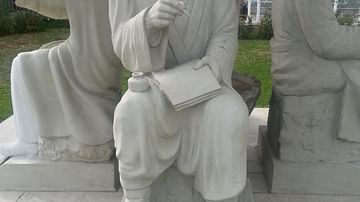
Omar Khayyam
Omar Khayyam (also given as Umar Khayyam, l. 1048-1131 CE) was a Persian polymath, astronomer, mathematician, and philosopher but is best known in the West as a poet, the author of The Rubaiyat of Omar Khayyam. His famous work has...

Definition
Ardashir I
Ardashir I (l. c. 180-241 CE, r. 224-240 CE) was the founder of the Persian Sassanian Empire (224-651 CE) and father of the great Sassanian king Shapur I (r. 240-270 CE). He is also known as Ardashir I Babakan, Ardeshir I, Ardashir...

Definition
Longmen Grottoes
The Longmen Grottoes, a Buddhist cave complex located 13 kilometers south of Luoyang in China's Henan province, form some of the most significant and exquisite representations of ancient Chinese stone art. Created over the course...

Definition
Silk in Antiquity
Silk is a fabric first produced in Neolithic China from the filaments of the cocoon of the silk worm. It became a staple source of income for small farmers and, as weaving techniques improved, the reputation of Chinese silk spread...

Definition
Hammurabi - Conquerer, King, and Law-Giver
Hammurabi (reign 1792-1750 BCE) was the sixth king of the Amorite First Dynasty of Babylon, best known for his famous law code, which served as the model for others, including the Mosaic Law of the Bible. He...
