
Search
Remove Ads
Advertisement
Search Results

Definition
Sixth Crusade
The Sixth Crusade (1228-1229 CE), which for many historians was merely the delayed final chapter of the unsuccessful Fifth Crusade (1217-1221 CE), finally saw the Holy Roman Emperor Frederick II (r. 1220-1250 CE) arrive with his...
Definition
Wako - The Medieval Pirates of Southeast Asia
Wako (aka wokou and waegu) is a term used to refer to Japanese (but also including Chinese, Korean, and Portuguese) pirates who plagued the seas of East Asia from Korea to Indonesia, especially between the...

Definition
Parthian Religion
Parthian religion might be best described with two words: inclusive and evolving. As Parthia's empire held within it a variety of cultures, the Parthians wisely left each to their own beliefs and traditions, like the Seleucid...

Definition
Chariot
The chariot was a light vehicle, usually on two wheels, drawn by one or more horses, often carrying two standing persons, a driver and a fighter using bow-and-arrow or javelins. The chariot was the supreme military weapon in Eurasia...

Definition
Caesarea Maritima
Caesarea Maritima was a city built over 2,000 years ago (c. 22-10 BCE) on the coast of the Eastern Mediterranean. With Roman engineering and largesse, Herod the Great (r. 37-4 BCE) accomplished this feat by constructing a whole...
Definition
Ancient Chinese Architecture
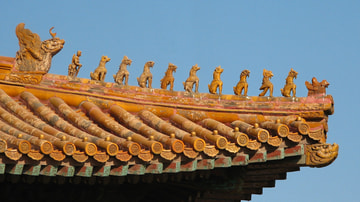
Walled compounds, raised pavilions, wooden columns and panelling, yellow glazed roof tiles, landscaped gardens, and a careful application of town planning and use of space are all notable features of the architecture...

Definition
Krak Des Chevaliers
Krak des Chevaliers (also spelt Cracs des Chevaliers, and known in Arabic as Hisn al-Akrad) is a castle in Syria originally built for the Emir of Aleppo in 1031 CE but acquired and extensively rebuilt by the Knights Hospitaller...

Definition
Shapur II
Shapur II (r. 309-379 CE, also Sapur II) was the tenth monarch of the Sassanian Empire (224-651 CE) and among the most successful. Under his reign – which lasted his entire life – the Avesta (Zoroastrian scripture) was committed to...

Definition
Hurrians
The Hurrians (aka Hurri or Khurri) were a Bronze Age people who flourished across the Near East from the 4th millennium BCE to the 1st millennium BCE. Hurrian is also the name of the language these people spoke and, indeed, is the one...

Definition
Yongle Emperor
The Yongle Emperor (aka Chengzu or Yung Lo, r. 1403-1424 CE) was the third ruler of the Chinese Ming Dynasty (1368-1644 CE). Inheriting a stable state thanks to the work of his father, the Hongwu Emperor (r. 1368-1398 CE), Yongle...
