
Search
Remove Ads
Advertisement
Search Results

Definition
Stono Rebellion
The Stono Rebellion (also known as Cato's Rebellion or Cato's Conspiracy, 9 September 1739) was the largest slave revolt in the British colonies of North America. Led by an educated slave, Cato (also known as Jemmy), enslaved...

Article
The Sky Beings: Thunder and His Helpers
The Sky Beings: Thunder and His Helpers is a legend of the Haudenosaunee (Iroquois) Confederacy of the Six Nations of the Cayuga, Mohawk, Oneida, Onondaga, Seneca, and Tuscarora. The story features the supernatural...

Article
How the Rabbit Lost His Tail
How the Rabbit Lost His Tail is a Sioux legend, part origin myth and part didactic tale, explaining why the rabbit looks as it does, why the owl is a night bird, and how one should treat a member of one’s family and...

Article
Scythian Territorial Expanse
With 7600 perimeter miles (12,231 km), the Scythians roamed and ruled over an astonishing 1.5 million mi² (2.4 million km²) of territory between the 7th and 3rd centuries BCE. Although building an empire was never in...
Article
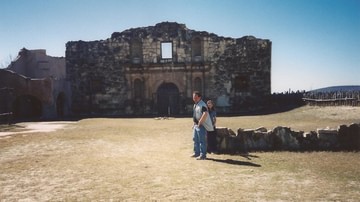
Ghosts of the Alamo - The Most Haunted Place in Texas
Toward the end of The Ballad of the Alamo (1960), recording artist Marty Robbins sings: Now the bugles are silent And there's rust on each sword And the small band of soldiers Lie asleep in the...

Article
The Boy Who Saw A-ti'us
The Boy Who Saw A-ti'us is a legend of the Pawnee nation about a young man who is granted a vision of the Creator Ti-ra'wa A-ti'us (also known simply as Ti-ra'wa or as A-ti'us) and, through his faith, is able to see what...

Article
The River of Separation, a Navajo Creation Story
The River of Separation is one of the many versions of the Navajo creation story detailing how the people first came up from below the earth, learned to live on its surface and, just as importantly, learned...
Article
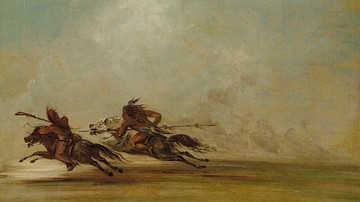
The Brave Who Went on the Warpath Alone and Won the Name of the Lone Warrior
The Brave Who Went on the Warpath Alone and Won the Name of the Lone Warrior is a Sioux tale in the tradition of the hero's journey in which a young person overcomes seemingly impossible...
Definition
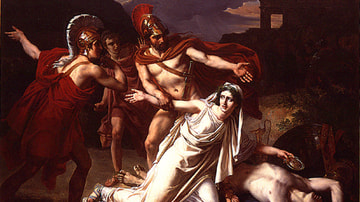
Antigone
Antigone was the third play in the Oedipus trilogy written by the great Greek playwright Sophocles (c. 496 - c. 406 BCE). Produced around 441 BCE and receiving first prize at the Dionysia festival, the tragedy was actually written long...

Definition
Gospel of John
In the canon of the New Testament, the fourth gospel of John is uniquely different from the other three, known as the Synoptics ("seen together"). Mark, Matthew, and Luke have parallel ministries and methods of relating the story...
