
Search
Remove Ads
Advertisement
Search Results

Article
Queen Hatshepsut: Daughter of Amun, Pharaoh of Egypt
Hatshepsut, whose name means "Foremost of Noble Women" or "First Among Noble Women" (royal name, Ma'at-ka-re, translated as "spirit of harmony and truth") was the fifth ruler of the 18th Dynasty (r...

Definition
Greek Philosophy
Ancient Greek philosophy is a system of thought, first developed in the 6th century BCE, which was informed by a focus on the First Cause of observable phenomena. Prior to the development of this system by Thales of Miletus (l...

Definition
Upanishads
The Upanishads are the philosophical-religious texts of Hinduism (also known as Sanatan Dharma meaning “Eternal Order” or “Eternal Path”) which develop and explain the fundamental tenets of the religion. The name is translated as...
Definition
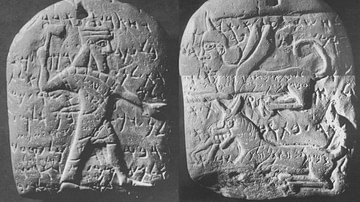
Arslan Tash Amulet
Dated to the 7th century BCE, the Arslan Tash amulet (AT1) was discovered in Arslan Tash, Syria and contains the writing of Phoenician, magic incantations. The limestone plaque includes a variety of features: incantations perceived...

Definition
Sumer - The Cradle of Civilization
Sumer was the southernmost region of ancient Mesopotamia (modern-day southern Iraq and parts of Kuwait), which has long been considered the cradle of civilization. The name comes from Akkadian, the language of the...

Definition
Near East - A Modern Term for an Ancient Land
The 'Near East' is a modern-age term for the region formerly known as the 'Middle East,' comprising Armenia, Cyprus, Egypt, Iraq, Iran, Israel, Jordan, Lebanon, Palestine, Syria, and part of Turkey, corresponding...

Article
The Propaganda of Octavian and Mark Antony's Civil War
Propaganda played an important role in Octavian (l. 63 BCE - 14 CE) and Mark Antony's (l. 83 – 30 BCE) civil war, and once victorious at the Battle of Actium (31 BCE), Octavian returned home to become...
Definition
Arthashastra
The Arthashastra is an Indian treatise on politics, economics, military strategy, the function of the state, and social organization attributed to the philosopher and Prime Minister Kautilya (also known as Chanakya, Vishnugupta...

Definition
Ptolemaic Dynasty
The Ptolemaic dynasty was a Macedonian royal family that ruled Ptolemaic Egypt from 323 to 30 BCE. It was founded by Ptolemy I, a general and successor of Alexander the Great. They built Alexandria, including the Lighthouse of...

Article
Enlil in the E-kur - Praising God in Ancient Mesopotamia
Enlil in the E-Kur (circa 2000 BCE) is a Sumerian hymn praising the sky god Enlil, his temple/ziggurat at Nippur, and his consort Ninlil, depicting all three in glowing terms and Enlil as a creator...
