
Search
Remove Ads
Advertisement
Search Results

Article
Ancient Mesopotamian Beliefs in the Afterlife
Unlike the rich corpus of ancient Egyptian funerary texts, no such “guidebooks” from Mesopotamia detail the afterlife and the soul's fate after death. Instead, ancient Mesopotamian views of the afterlife...

Article
Byzantine Icons
Icons, that is images of holy persons, were an important part of the Byzantine Christian Church from the 3rd century CE onwards. Venerated in churches, public places, and private homes, they were often believed to have protective...
Article
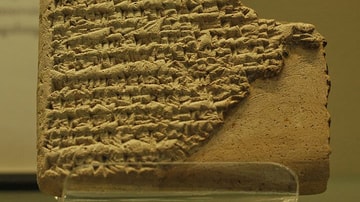
The Legend of Sargon of Akkad - Inspiration for the Story of Moses
The Legend of Sargon of Akkad (circa 2300 BCE) is an Akkadian work from Mesopotamia understood as the autobiography of Sargon of Akkad (Sargon the Great, reign 2334-2279 BCE), founder of...

Definition
The Mórrigan
The Mórrigan (also Morrighan, Môr-Riogain or Morrigu), usually referred to with the definite article, was a great warrior-queen goddess in Irish-Celtic mythology. She was most associated with inciting war, then stirring up the fury...

Definition
Seleucus I Nicator
Seleucus I Nicator (l. c. 358-281 BCE, r. 305-281 BCE) was one of the generals of Alexander the Great (l. 356-323 BCE) who made up the group of Diadochi ("successors") who divided the vast Macedonian Empire between them after...

Definition
First Intermediate Period of Egypt - Era of Transformation
The First Intermediate Period of Egypt (2181-2040 BCE) is the era that followed the Old Kingdom (circa 2613-2181 BCE) and preceded the Middle Kingdom (2040-1782 BCE) periods of Egyptian history...
Definition
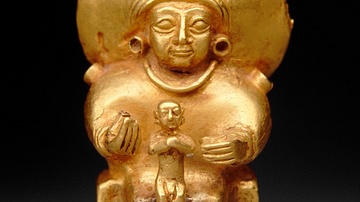
Sauska - The Hurrian's Radiant Goddess of Fertility and War
Sauska (also known as Shaushka, Sausga, and Anzili) was the Hurrian-Hittite goddess of fertility, war, and healing. She was worshipped throughout the region known as Hanigalbat (present day Iraq...

Definition
Gandhara Civilization
The Gandhara Civilization existed in what is now Northern Pakistan and Afghanistan from the middle of the 1st millennium BCE to the beginning of the 2nd millennium CE. Although multiple major powers ruled over this area during...

Definition
Anu - Mesopotamian Father of the Gods
Anu (also known as An) is an early Mesopotamian sky god who was later viewed as the Father of the Gods and ruler of the heavens, a position which then passed to his son Enlil. He is the son of the couple Anshar...

Definition
Samuel
Samuel is a character in the Hebrew Bible and the Old Testament, uniquely depicted as having served several roles, as judge, military leader, seer, prophet, kingmaker, priestly official, and loyal servant of Yahweh. He is traditionally...
