
Search
Remove Ads
Advertisement
Search Results

Definition
James I of Scotland
James I of Scotland ruled as king from 1406 to 1437. In 1406, the future king was captured by pirates and then imprisoned by Henry IV of England (r. 1399-1413), a confinement that lasted for 18 years. He succeeded his father...

Definition
James IV of Scotland
James IV of Scotland ruled as king from 1488 to 1513. He succeeded his father James III of Scotland (r. 1460-1488) and became one of the most popular of the Stuart kings. James sought to apply justice in every corner of his...
Definition
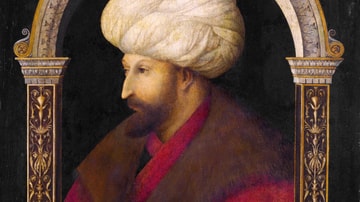
Mehmed II
Mehmed II (1432-1481 CE), also known as Mehmed the Conqueror, was the seventh and among the greatest sultans of the Ottoman Empire. His conquests consolidated Ottoman rule in Anatolia and the Balkans, and he most famously triumphed...

Definition
William Brewster
William Brewster (l. 1568-1644 CE) was an elder of the Leiden congregation of separatists (later known as pilgrims) and their spiritual leader while onboard the Mayflower and later after the establishment of the Plymouth Colony...

Definition
Matilda of Tuscany
Matilda of Canossa (c. 1046-1115), the Countess of Tuscany (r. 1055-1115) and Vice-Queen of Italy (r. 1111-1115), was the final head of the noble House of Canossa following the deaths of her father in 1052 and her elder brother...

Definition
Paul Cézanne
Paul Cézanne (1839-1906) was a French post-impressionist artist. Although he struggled for recognition in his own lifetime and often lacked confidence in his work, the artist's unique style, use of light and colour, and his interest...

Definition
Sepoy
A sepoy was an Indian soldier in the armies of various states and European trading companies in the Indian subcontinent and then, from the second half of the 19th century, in the British Indian Army. Recruited from many different population...

Definition
Edward Gibbon
Edward Gibbon (1737-1794) was an English historian most famous for his influential work The History of the Decline and Fall of the Roman Empire, volume one of which was published in 1776, with the final sixth volume coming in 1788...

Definition
Mauryan Empire
The Mauryan Empire (322 BCE - 185 BCE) supplanted the earlier Magadha Kingdom to assume power over large tracts of eastern and northern India. At its height, the empire stretched over parts of modern Iran and almost the entire...

Definition
British Industrial Revolution
The British Industrial Revolution (1760-1840) brought innovative mechanisation and deep social change. The process saw the invention of steam-powered machines, which were used in factories in ever-growing urban centres...
