
Search
Remove Ads
Advertisement
Search Results

Article
Spartan Women
Spartan women had more rights and enjoyed greater autonomy than women in any other Greek city-state of the Classical Period (5th-4th centuries BCE). Women could inherit property, own land, make business transactions, and were better...
Article
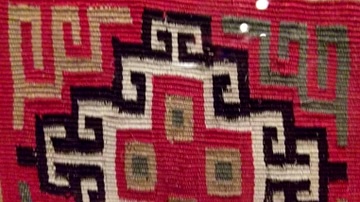
Inca Textiles
For the Incas finely worked and highly decorative textiles came to symbolize both wealth and status, fine cloth could be used as both a tax and currency, and the very best textiles became amongst the most prized of all possessions...

Article
The Invention of the First Coinage in Ancient Lydia
Money may take many forms, from the digital code of cryptocurrency to the woodpecker scalps favoured in early California. People have also used cattle, cacao beans, cowrie shells, chewing gum, grain...

Article
Lenin's New Economic Policy - Communism's Flirtation with Capitalism
The New Economic Policy (NEP) of Vladimir Lenin (1870-1924), leader of Soviet Russia, was the introduction in 1921 of a limited form of capitalism in light industry and agriculture. Contrary...

Article
Achaemenid Kings List & Commentary
The Achaemenid Empire (c. 550-330 BCE) was the first great Persian political entity in Western and Central Asia which stretched, at its peak, from Asia Minor to the Indus Valley and Mesopotamia through Egypt. It...

Article
Trade in Ancient Celtic Europe
Trade in raw materials and manufactured goods in ancient Celtic Europe was vibrant and far-reaching, particularly regarding the centre of the continent where there was a hub of well-established trade routes. As the...

Article
Enemies of Rome in the 3rd Century CE - The Greatest Enemy of Rome was Rome Itself
It has been said that the greatest enemy of Rome was Rome itself, and this is certainly true of the period known as the Crisis of the Third Century (also known as the Imperial...

Video
Understanding Money in Colonial America
Michael Goudket, the Adjutant General of the Order of the Ancient & Honorable Huntington Militia, explains currency used in 18th Century Colonial America. To better understand daily life and material culture...

Video
Why do Ex-British Colonies use Dollars Instead of Pounds? (Short Animated Documentary)
You'll notice that many ex-British Colonies, like Australia, Canada and New Zealand don't use pounds like their former British overlords but instead use dollars. Why? What...
Image
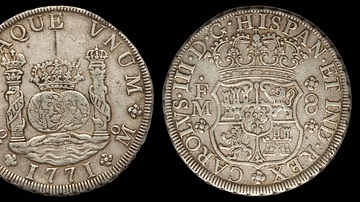
Spanish Silver Dollar, 1771
Spanish silver dollar from the reign of Charles III of Spain (r. 1759–1788). Minted in Mexico, under the authority of the Kingdom of Spain, 1771.
