
Search
Did you mean: Chiron?
Remove Ads
Advertisement
Search Results

Definition
Joachim Murat
Joachim Murat (1767-1815) was a French cavalry officer who fought in the French Revolutionary Wars (1792-1802) and Napoleonic Wars (1803-1815). He was appointed marshal of the French Empire in 1804, Grand Duke of Berg in 1806, and...
Definition
Stamp Act
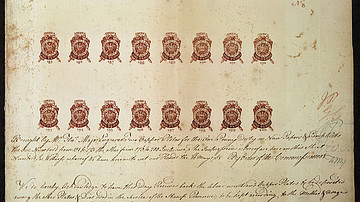
The Stamp Act of 1765 was the first direct tax imposed on the 13 American colonies by the Parliament of Great Britain. It required the colonists to pay a tax on all printed materials including newspapers, legal documents, magazines...

Definition
Intolerable Acts
The Intolerable Acts, also known as the Coercive Acts, were five laws passed by the Parliament of Great Britain in 1774 to punish the Thirteen Colonies of British North America for the Boston Tea Party. Though the acts primarily...

Definition
Nuremberg Rally
The Nuremberg Rally, or the Reich Party Congress, was an annual event held from 1927 to 1938 in Nürnberg, Germany. Organised on a massive scale by the National Socialist Party (Nazi), these operations in pomp, ceremony, and propaganda...

Definition
King George's War - When New England Colonists Captured A Powerful French Fort
King George's War (1744-1748) was the third great colonial conflict fought in North America between Great Britain and France, each side aided by their respective Native American...

Definition
Ashurbanipal
Ashurbanipal (r. 668-627 BCE, also known as Assurbanipal) was the last of the great kings of Assyria. His name means "the god Ashur is creator of an heir" and he was the son of King Esarhaddon of the Neo-Assyrian Empire. In the Hebrew...

Definition
Delphi
Delphi was an important ancient Greek religious sanctuary sacred to the god Apollo. Located on Mt. Parnassus near the Gulf of Corinth, it was home to the famous oracle of Apollo which gave cryptic predictions and guidance to both city-states...

Definition
Byzantine Empire
The Byzantine Empire existed from 330 to 1453. It is often called the Eastern Roman Empire or simply Byzantium. The Byzantine capital was founded at Constantinople by Constantine I (r. 306-337). The Byzantine Empire varied in...

Definition
Nemea
Nemea was a religious sanctuary in the northern Peloponnese of Greece where pan-Hellenic athletic games were held every two years from 573 BCE until 271 BCE, after which, the Games were definitively moved to Argos. Early Settlement...
Definition
Alemanni
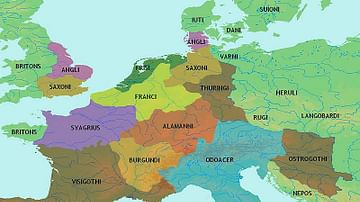
The Alemanni (also known as the Alamanni and the Alamans, meaning "All Men" or "Men United") were a confederacy of Germanic-speaking people who occupied the regions south of the Main and east of the Rhine rivers in present-day Germany...
