
Search
Remove Ads
Advertisement
Search Results

Image
Winged Nike Relief in Ephesus
Winged Nike relief, photograph by Juan Ángel Piqueras, Ephesus, Selçuk, İzmir, Türkiye, 2 March 2026. This marble relief of the Greek goddess of victory Nike (known to the Romans as Victoria) is dated to the 1st-2nd...

Image
Fountain of Trajan, Ephesus
Built around 104 CE, the fountain of Trajan is one of the finest monuments in Ephesus. It was constructed in honor of Roman Emperor Trajan. The pool of the fountain was 20×10 meters, surrounded by columns and statues...

Image
Library of Celsus, Ephesus
Completed in 117 CE, the Library of Celsus at Ephesus was ordered built by Tiberius Julius Acquila in memory of his father Tiberius Julius Celsus Polemaeanus, proconsul (governor) of the Asian province c. 105 to 114 CE.

Image
The Fountain of Pollio, Ephesus
The Fountain of Pollio at Ephesus was built in 97 CE by C. S. Pollio, in memory of Sextillius Pollio, the builder of the famous aqueduct which carried water to all the fountains in the city. In the years following...
Image
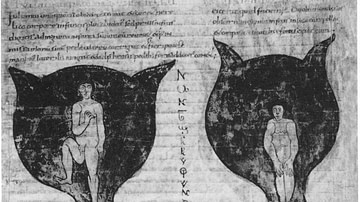
Positions of the Embryo in the Uterus in Soranus of Ephesus' Gynaecology
A Latin version of Gynaecology by Soranus of Ephesus, showing positions of the embryo in the uterus.
Codex 3714, fol. 28r.
Bibliothèque Royale, Brussels.
Image
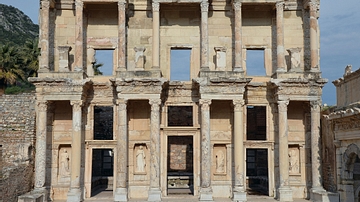
The Library of Celsus at Ephesus
The Library of Celsus at Ephesus was completed in 117 CE. It was built on the order of Tiberius Julius Acquila in memory of his father Tiberius Julius Celsus Polemaeanus, proconsul (governor) of the Asian province...
Image
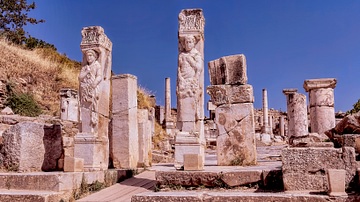
Hercules Gate, Ephesus
The Hercules Gate at Ephesus gets its name from the reliefs of Hercules that adorn its columns. Hercules is considered the greatest of Greek heroes, and the epitome of masculinity. In the reliefs, Hercules is depicted wearing...

Image
Ephesus terrace houses: Mosaics and Art
The terrace homes in Ephesus give a glimpse of how the wealthy lived during the Roman period The oldest building dates back into the 1C BCE and continued in use as a residence until the 7C CE.

Image
Ephesus
Ruins of the ancient city of Ephesus in Turkey
Image
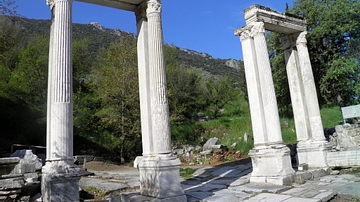
Hadrian’s Gate at Ephesus
This gate, located at the end of Curetes Street in Ephesus (Turkey), was dedicated to Hadrian in honour of the Emperor's visit to the city (in 124 or 129 CE).
