
Search
Remove Ads
Advertisement
Search Results
Definition
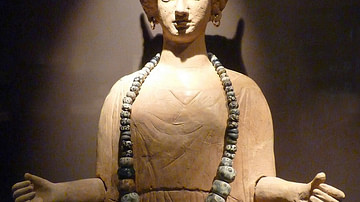
Carthaginian Religion
Carthage was founded by the Phoenician city of Tyre in the 9th century BCE, and along with many other cultural practices, the city adopted aspects of the religion of its founding fathers. Polytheistic in nature, such important...

Definition
Constantine I
Constantine I, aka Constantine the Great, was Roman emperor from 306 to 337 CE. Realizing that the Roman Empire was too large for one man to adequately rule, Emperor Diocletian (284-305 CE) split the empire into two, creating a...

Definition
Delphi
Delphi was an important ancient Greek religious sanctuary sacred to the god Apollo. Located on Mt. Parnassus near the Gulf of Corinth, it was home to the famous oracle of Apollo which gave cryptic predictions and guidance to both city-states...

Definition
Vercingetorix
Vercingetorix (82-46 BCE) was a Gallic chieftain who rallied the tribes of Gaul (modern-day France) to repel the Roman invasion of Julius Caesar in 52 BCE. His name means "Victor of a Hundred Battles" and was not his birth name...

Definition
Constantine V
Constantine V, also known as Constantine the Dung-named by his enemies, was emperor of the Byzantine empire from 741 to 775 CE. He enjoyed military successes in the Middle East and Balkans but his reign is chiefly remembered for...

Definition
Second Crusade
The Second Crusade (1147-1149) was a military campaign organised by the Pope and European nobles to recapture the city of Edessa in Mesopotamia which had fallen in 1144 to the Muslim Seljuk Turks. Despite an army of 60,000 and...

Definition
The Clouds
The Clouds is a comedy written c. 423 BCE by the Greek playwright Aristophanes (c. 448 BCE – c. 385 BCE). A failure at the Dionysia competition, finishing third out of three, it was revised later in 418 BCE but never produced in the...

Definition
Songhai Empire
The Songhai Empire (aka Songhay, c. 1460 - c. 1591) covered what is today southern Mauritania and Mali. It replaced the Mali Empire (1240-1645) as the most important state in West Africa. Originating as a smaller kingdom along...

Definition
Leonardo da Vinci
Leonardo da Vinci (1452-1519) was an Italian Renaissance artist, architect, engineer, and scientist. He is renowned for his ability to observe and capture nature, scientific phenomena, and human emotions in all media. Leonardo’s...

Definition
Oyo Empire
The Oyo Empire flourished from the 17th to 19th century CE in what is today southwest Nigeria. The Oyo forged an empire thanks to their formidable cavalry units and so came to dominate other Yoruba peoples of the region. The Oyo Empire...
