
Search
Remove Ads
Advertisement
Search Results

Article
First Battle of the Marne - How Paris was Saved in World War I
The First Battle of the Marne, fought between 6 and 10 September 1914, was a major and successful Allied counterattack against the German invasion of French territory the previous August. Often referred to as the ‘Miracle of the Marne', the...

Article
Hadrian's Travels
No other Roman emperor travelled as much as Hadrian (r. 117-138 CE). The 'restless' emperor spent more time travelling than in Rome, devoting half of his 21-year reign to the inspection of the provinces. His travels provided him with the...
Article
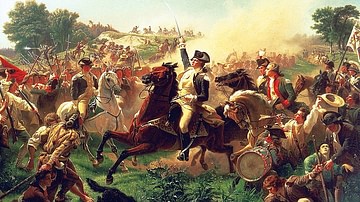
Battle of Monmouth
The Battle of Monmouth (28 June 1778), or the Battle of Monmouth Court House, was the last battle of the Philadelphia Campaign during the American Revolutionary War (1775-1783). After abandoning control of Philadelphia, the British army under...

Article
Ethnicity & Identity Within the Four-Room House
The process of determining ethnicity is a problematic venture, even more so when interpreted through the archaeological record. Despite this issue, evidence, such as the four-room house, has been preserved that can be interpreted to represent...
Interview
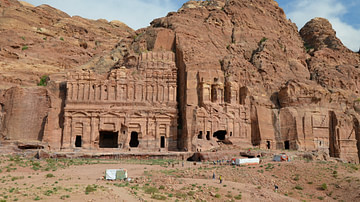
ArchaeoConcept Interview
ArchaeoConcept is an independent company based in Biel, Switzerland that finds solutions to problems encountered by archaeologists and heritage managers which cannot be answered from within existing structures. Through its integrative projects...

Definition
Mesopotamia - The Beginning of Beginnings
Mesopotamia (from the Greek, meaning "between two rivers") was an ancient region located in the Near East (Middle East) bounded in the northeast by the Zagros Mountains and in the southeast by the Arabian Plateau, corresponding to modern-day...

Definition
Mongol Empire
The Mongol Empire (1206-1368) was founded by Genghis Khan (r. 1206-1227), first Great Khan or 'universal ruler' of the Mongol peoples. Genghis forged the empire by uniting nomadic tribes of the Asian steppe and creating a devastatingly effective...

Definition
Cuneiform - The Writing System That Made History
Cuneiform is a system of writing first developed by the ancient Sumerians of Mesopotamia circa 3600/3500 BCE. It is considered the most significant among the many cultural contributions of the Sumerians and the greatest among those of the...

Definition
Ancient China
Ancient China produced what has become the oldest extant culture in the world. The name 'China' comes from the Sanskrit Cina (derived from the name of the Chinese Qin Dynasty, pronounced 'Chin') which was translated as 'Cin' by the Persians...

Definition
Byzantine Empire
The Byzantine Empire existed from 330 to 1453. It is often called the Eastern Roman Empire or simply Byzantium. The Byzantine capital was founded at Constantinople by Constantine I (r. 306-337). The Byzantine Empire varied in size over the...
