
Search
Did you mean: Olympia?
Remove Ads
Advertisement
Search Results
Image
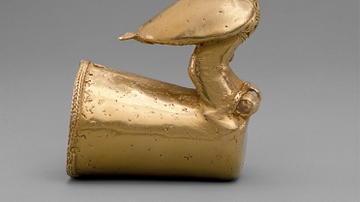
Gold Staff Finial, Zenu Culture
A gold staff finial made by the Zenúes, a people who belonged to the Zenú tribe of ancient Colombia. It features an owl on the edge with a majestic crest, polished golden wings and false filigree openwork on its chest. Distinctive features...
Image
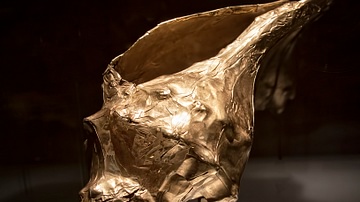
Colombian Gold Snail Shell
Gold snail shell, 100 BCE - 1000 CE. Restrepo, Valle del Cauca, Colombia. 14,8 x 30 cm (5.8 x 11.8 inches). Museo del Oro / The Gold's Museum (Bogota, Colombia).
Image
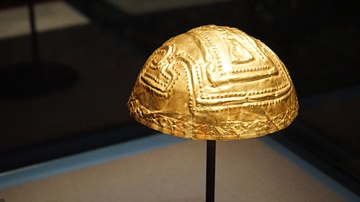
Colombian Gold Helmet
Gold alloy (tumbaga), 500 BCE - 700 BCE. Colombia. Gold was an important material in ancient Colombia. It had a symbolic association with the creative energy of the Sun. This helmet would not have been used in battle but instead would...

Definition
Francisco Pizarro
Francisco Pizarro (c. 1478-1541) was a conquistador who led the Spanish conquest of the Inca civilization from 1532. With only a small group of men, Pizarro took advantage of his superior weapons and the fact that the Incas were weakened...

Definition
Hernando de Soto
Hernando de Soto (c. 1500-1542) was a Spanish conquistador who fought in Panama and Nicaragua and accompanied Francisco Pizarro (c. 1478-1541) in the conquest of the Inca civilization in Peru. He famously explored North America, including...

Article
Pizarro & the Fall of the Inca Empire
In 1533 CE the Inca Empire was the largest in the world. It extended across western South America from Quito in the north to Santiago in the south. However, the lack of integration of conquered peoples into that empire, combined with a civil...

Article
Treasure Ports of the Spanish Main
The treasure ports of the Spanish Main such as Cartagena, Portobelo, Panama, and Veracruz were used to collect the riches the Spanish Empire had extracted from the Americas, ready for transport in the two annual treasure fleets back to Europe...
Image
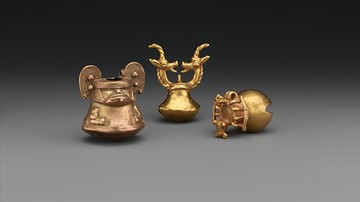
Tumbaga Bells of the Tairona Civilization
Bells made from an alloy of gold and copper (tumbaga) by the Tairona people of Colombia. c. 1500 A.D.

Image
Battle of Cartagena de Indias, 1741
A Perspective View of the Action at Cartagena, etching, c. 1741. Depicted here is the harbour at Cartagena de Indias, in what is now Colombia, besieged by the Kingdom of Great Britain's Royal Navy during the War of Jenkins' Ear (1739-1748...

Image
Lime Container (Poporo), Quimbaya Civilization
A Poporo is a container used for storing lime that could be procured by crushing seashells and would later be eaten with coca leaves- a tradition in Pre-Columbian South America. This Poporo, made out of gold with a nude female figure carved...
