
Search
Did you mean: Olympia?
Remove Ads
Advertisement
Search Results
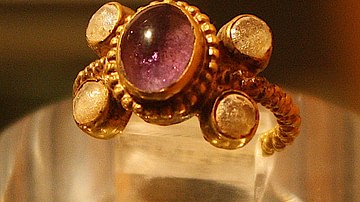
Image Gallery
A Gallery of Bling through the Ages
In this gallery, we showcase 40 precious items that illustrate the love of valuable shiny things that can sparkle up our daily lives is far from being a modern phenomenon. Gold has always been valued for its gleam and incorruptibility, while...

Image
Map of the Spanish Conquest & Exploration in South America
Spain’s rapid expansion into South America followed the consolidation of its Caribbean footholds by 1512, marking a decisive shift from exploration to imperial conquest. Under the reign of Ferdinand II of Aragon (reign1479–1516) and later...

Image
Tairona Pendant
A gold pendant made by the Tairona people, representing a shaman holding two sceptres, wearing a large nasal ornament and headgear with two toucans. Lost-wax cast gold with false filigree decoration, 10th-15th century CE, Colombia. (Louvre...

Image
Muisca Gold Figure
A Muisca (Chibcha) seated gold figure on a stool (tunjo). Colombia, 10th-16th century CE. (Metropolitan Museum of Art, New York)

Image
The Pull of the Monroe Magnet
The Pull of the Monroe Magnet, illustration by Udo J. Keppler, 1913. In this cartoon depiction of the Monroe Doctrine, a colossal Uncle Sam, a national personification of the United States, forcibly draws toward himself figures representing...
Image
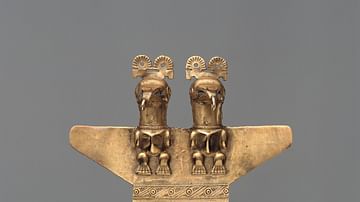
Muisca Double Eagle Pendant
A Muisca (Chibcha) double eagle gold pendant. Colombia, 10th-16th century CE. (Metropolitan Museum of Art, New York)
Image
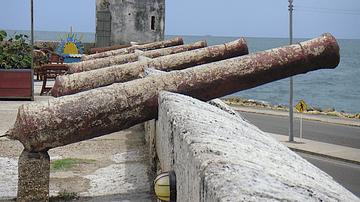
Cannons at Cartagena
A number of cannons at the 16-17th-century fortress of Cartagena, Colombia. Cartagena was one of the principal treasure ports of the Spanish Main and its mighty fortress was sufficient to deter the buccaneers.
Image
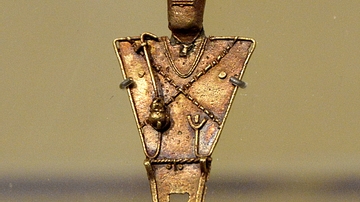
Muisca Male Tunjo
This figure depicts a male; he holds an object with his right hand. A material of religious significance, the flat gold figures (or Tunjos), were votive offerings left in caves or lakes. They were rarely found inside tombs. Pre-Columbian...

Image
El Doble Yo Funerary Statue, Alto de Las Piedras
Megalithic funerary statue referred to as El Doble Yo at Alto de Las Piedras near San Agustín, Huila Department, Colombia. Created c. 1st to 10th century CE.

Image
Quimbaya Gold Necklace
Gold lends itself to the development of decorative techniques. Pre-Columbian pieces from South America were cast and decorated with twisted wire. From the Quimbaya civilization, Colombia, 11th to 16th century CE. (National Museum of Scotland...
