
Search
Did you mean: Copan?
Remove Ads
Advertisement
Search Results

Article
Coyote Tales of the Shasta Nation
The Coyote tales come from the Shasta people who originally inhabited the regions of modern-day northern California and southern Oregon. Coyote is a popular trickster figure among many Native peoples of North America...

Article
Battle of Rorke's Drift - Heroic Stand of the Anglo-Zulu War
Immediately after their famous victory over the British at the Battle of Isandlwana on 22 January 1879, as many as 4,000 Zulu warriors pushed on across the Zulu-Natal border. This Zulu army headed...

Article
Ghosts in Ancient Japan
Ghosts (obake or yurei) appear in ancient Japanese folklore and literature, usually in moral tales designed to both warn and entertain but they were also an important element of ancestor worship. If the deceased members...

Article
Caste System in Ancient India - Varna Ideals in Vedic Times
Ancient India in the Vedic Period (c. 1500-1000 BCE) did not have social stratification based on socio-economic indicators; rather, citizens were classified according to their Varna or castes...

Article
The Nerge: Hunting in the Mongol Empire
The peoples of the Mongol Empire (1206-1368 CE) were nomadic, and they relied on hunting wild game as a valuable source of protein. The Asian steppe is a desolate, windy, and often bitterly cold environment...

Article
Elves & Dwarves in Norse Mythology
Elves and dwarves represent minor divine figures in Norse mythology. Elves (álfar) and dwarves (dvergar) have in common their talent for creating precious objects, skill, agility, and moral ambiguity. Dwarves appear...

Article
How the Hopi Indians Reached Their World
How the Hopi Indians Reached Their World is the creation story of the Native American Hopi nation (the Hopi tribe of Arizona) located today within the Navajo Nation reservation. The legend details the ascent...

Definition
Heiankyo
Heiankyo (Kyoto), located in the centre of Honshu island, was the capital of Japan for over a thousand years and gave its name to one of the golden ages of Japanese history, the Heian Period (794-1185 CE). Built according to Chinese...
Image
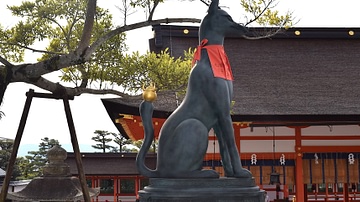
Fox Statue, Fushimi Inari Shrine
The Fushimi Inari Shrine near Kyoto (Heiankyo) is the largest and most important shrine dedicated to Inari, the Shinto god of rice and prosperity. It is famous for the large number of red gates (torii) at the site...

Image
Fushimi Inari Shrine in Kyoto, Japan
The Fushimi Inari Shrine near Kyoto (Heiankyo), Japan is the largest and most important shrine dedicated to Inari, the Shinto god of rice and prosperity. The shrine was founded in 711 CE by the Hata clan and moved...
