
Search
Remove Ads
Advertisement
Search Results
Image
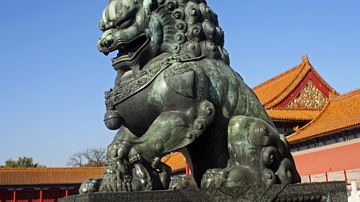
Chinese Lion-Dog
Bronze Lion-Dog (aka Foo-Dog) at the Forbidden City, Beijing, China. They are always placed in pairs; the male has a paw on an ornate ball, representing power and domination over the human affairs of the world while the female...

Image
Chinese Door Gods
In China gods (menshen) were often painted on either side of a doorway to guard against evil demons or ghosts.

Image
Chinese Zodiac
Jade Zodiac, Imperial Palace, Beijing, China

Image
Chinese Oracle Bone
Oracle bone from the reign of King Wu Ding (late Shang dynasty).

Definition
Lumbini
Lumbini is a village, archaeological site, and place of pilgrimage honored as the birthplace of Siddhartha Gautama (the Buddha, l. c. 563-483 BCE) located in modern-day Rupandehi District of Nepal, Province 5, near the Indian border...

Definition
Gwanggaeto the Great
Gwanggaeto (Kwanggaeto), often referred to as Gwanggaeto the Great, was king of the Goguryeo (Koguryo) kingdom which ruled northern Korea during the Three Kingdoms period. Gwanggaeto reigned between 391 and 413 CE, and living...

Definition
Emperor of Japan
The emperor of Japan is a position as the head of state which traditionally dates back to the 7th century BCE and the legendary figure of Emperor Jimmu (r. 660-585 BCE). Emperors came to be known as the Tenno or 'heavenly sovereign'...

Definition
Kapilavastu
Kapilavastu (“Place of Kapila”) is the name of the city where Siddhartha Gautama (the Buddha, l. c. 563-483 BCE) grew up and lived for the first 29 years of his life before leaving to pursue the spiritual path which led to his enlightenment...

Definition
Kinkakuji
Kinkakuji Temple in Kyoto, Japan, more formally referred to as Rokuon-ji or 'Deer Garden Temple' and otherwise known as 'The Temple of the Golden Pavilion', was first built in 1397 CE. Originally the retirement residence of the shogun...

Definition
Mongol Warfare
The Mongols conquered vast swathes of Asia in the 13th and 14th century CE thanks to their fast light cavalry and excellent bowmen, but another significant contribution to their success was the adoption of their enemies' tactics...
