
Search
Remove Ads
Advertisement
Search Results

Article
Alexander the Great as a God
The age-old concept of the “divine right of kings” allowed that a country's ruler received his or her power or authority from God. However, few, if any, were delusional enough to actually believe themselves to be a god...

Article
Diodorus Siculus' Account of the Life of Semiramis
Semiramis is the semi-divine Warrior-Queen of Assyria, whose reign is most clearly documented by the Greek historian Diodorus Siculus (l. 90-30 BCE) in his great work Bibliotheca Historica ("Historical...

Article
The Spice Trade & the Age of Exploration
One of the major motivating factors in the European Age of Exploration was the search for direct access to the highly lucrative Eastern spice trade. In the 15th century, spices came to Europe via the Middle...

Article
Cultural Links between India & the Greco-Roman World
Cyrus the Great (558-530 BCE) built the first universal empire, stretching from Greece to the Indus River. This was the famous Achaemenid Empire of Persia. An inscription at Naqsh-i-Rustam, the tomb...

Definition
Parthian Art
Parthian art flourished within the Eurasian cultural corridor from the late hundreds BCE to the early 1st and 2nd centuries CE. With the Parthian Empire (247 BCE - 224 CE) stretching from India and China in the east to the Mediterranean...

Interview
Rubin Museum's Faith and Empire: Tibetan Buddhist Art
Faith and Empire: Art and Politics in Tibetan Buddhism, a new exhibition at the Rubin Museum of Art in New York, explores the dynamic historical intersection of politics, religion, and art as reflected...

Definition
Gandhara Civilization
The Gandhara Civilization existed in what is now Northern Pakistan and Afghanistan from the middle of the 1st millennium BCE to the beginning of the 2nd millennium CE. Although multiple major powers ruled over this area during...

Article
The Journeys of Paul the Apostle
The journeys of Paul the Apostle, as the New Testament relates in the Book of Acts, started with his conversion experience on the way to Damascus, after which instead of seeking to thwart the growing Christian movement...
Definition
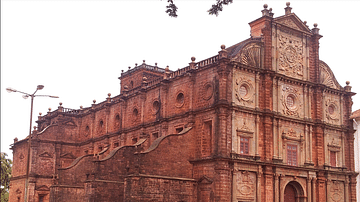
Portuguese Goa
Goa, located on the west coast of India, was a Portuguese colony from 1510 to 1961. The small coastal area was conquered by Afonso de Albuquerque (c. 1453-1515) and became an important trade hub for the Eastern spice trade. Goa...

Definition
Chagatai Khanate
The Chagatai Khanate (also Chaghatai, Jagatai, Chaghatay or Ca'adai, c. 1227-1363 CE) was that part of the Mongol Empire (1206-1368 CE) which covered what is today mostly Uzbekistan, southern Kazakhstan, and western Tajikistan...
