
Search
Remove Ads
Advertisement
Search Results

Definition
Eucratid
The Eucratids were a Greco-Bactrian and Indo-Greek dynasty of approximately 12 kings, lasting between c.171 BC and 80-70 BC, according to numismatic evidence. The numismatic emblem which characterized it were the palm and the Dioscuri...

Definition
Ancient Egyptian Warfare - The Force That Built an Empire
Ancient Egyptian Warfare developed from an army of conscripts in the Pre-Dynastic Period (circa 3150-2613 BCE) through the early era of the Middle Kingdom (2040-1782 BCE), supplied to the king by...

Definition
Arminius
The Cherusci noble Arminius (c. 18 BCE - 19 CE) led the resistance to Roman conquest of Germania during the years 9-16 CE. Likely raised as a child hostage in Rome, Arminius gained command of a German auxiliary cohort in the Roman army...

Definition
Christianity
Christianity is the world's largest religion, with 2.8 billion adherents. It is categorized as one of the three Abrahamic or monotheistic religions of the Western tradition along with Judaism and Islam. 'Christian' is derived from...

Definition
Hyangga
Hyangga was a form poetical 'country song,' distinct from contemporary Chinese songs, which were written in the Silla and Goryeo kingdoms of ancient Korea between the 7th and 10th century CE. The indigenous songs cover such topics as...

Definition
Commodus
Commodus was Roman emperor from 180 to 192 CE. With the death of Roman Emperor Marcus Aurelius in March of 180 CE, the long reign of the five good emperors came to an end and with it so did the Pax Romana (the Roman Peace). Those emperors...

Definition
Egyptian Papyrus
Papyrus is a plant (cyperus papyrus) which once grew in abundance, primarily in the wilds of the Egyptian Delta but also elsewhere in the Nile River Valley, but is now quite rare. Papyrus buds opened from a horizontal root growing...

Definition
Later Three Kingdoms Period
The Later Three Kingdoms period (889-935 CE) of ancient Korea saw a partial revival of the old three kingdoms which had dominated the peninsula from the 1st century BCE to the 7th century CE. After the Unified Silla kingdom...

Definition
Clovis I
Clovis I (or Chlodovech, 466-511/513 CE), king of the Franks, is considered the founding father of the Merovingian Dynasty, which would continue for over 200 years. Clovis became king at the age of 15, and by the time of his death 30...
Definition
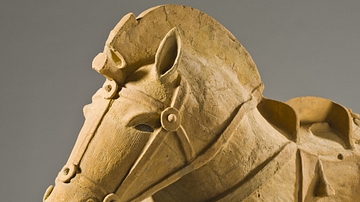
Haniwa
Haniwa are the unglazed terracotta rings, cylinders, and figures of people, animals, and houses which were deposited at Japanese tombs during the Kofun and Asuka Periods (c. 250-710 CE). The exact purpose of these offerings is not known...
