
Search
Remove Ads
Advertisement
Search Results

Image
German Bunker, Gold Beach
A captured German bunker with 50-mm gun at Gold Beach, attacked during the D-Day Normandy landings of 6 June 1944. (Imperial War Museums)
Image
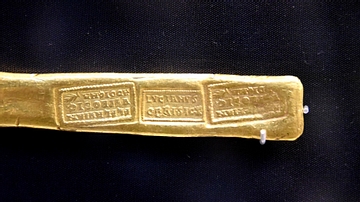
Roman Gold Bar Stamped with Assayers
In the Late Roman Period, precious metal that had been paid in tax was melted down into bars before being re-minted, to eliminate plated forgeries. Because local mint officials could be corrupt, the bars were stamped...
Image
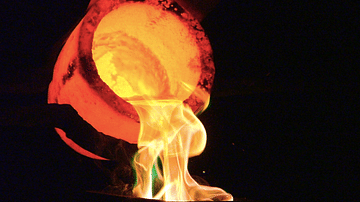
Liquid Gold
A photograph of liquid gold in a refinery.
Image
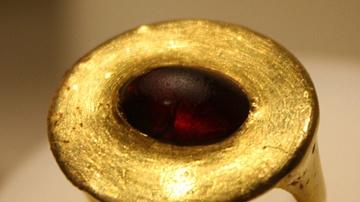
Gold & Garnet Ring, Agrigento
A gold and garnet ring from Agrigento, Sicily, 3rd century BCE. (Archaeological Museum of Agrigento).
Image
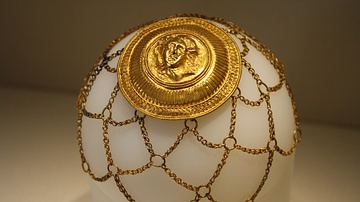
Gold Hair Ornament
Gold hair ornament from Agrigento, Sicily, 3rd century BCE. The central medallion depicts Medusa.
Archaeological Museum of Agrigento.
Image
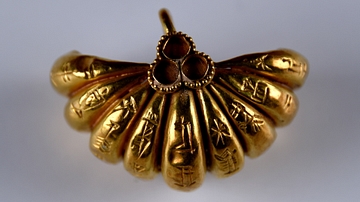
Cuneiform, Gold Earring from Ur III
This is the upper surface of the earring. Note how the cuneiform signs were carved and distributed and their distance from the center. The cuneiform text is read vertically, from the upper surface downwards on...
Image
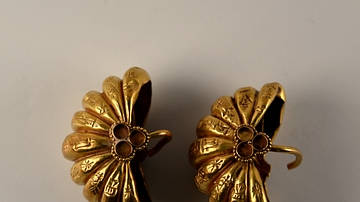
Side View, Gold Earrings, Ur III
These are the upper surfaces of both earrings, with their concavity facing right. Note that the cuneiform signs are identical on the corresponding sides. A pair of gold earrings, 24 carats, approximately 48 grams...
Image
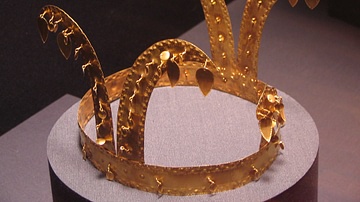
Gold Gaya Crown
A gold crown from the Gaya confederacy, 42-532 CE, southern Korea. (National Museum of Korea, Seoul, South Korea)
Image
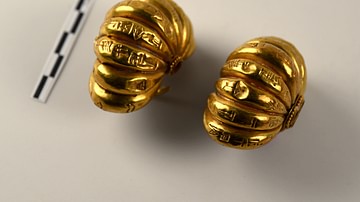
Mesopotamian Gold Earrings, Ur III
Both earrings are placed in a mirror-image position, with the lower surfaces facing each other. Each earring is composed of nine lunar-shaped segments forming a flattened half- ball. The cuneiform signs run vertically...
Image
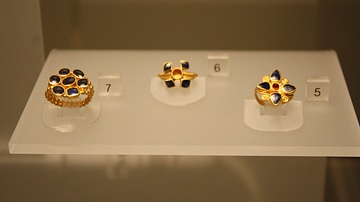
Roman Gold & Saphire Rings
Roman gold and saphire rings, second half of the 2nd century CE. The ring on the right has a garnet centre stone. From an unidentified marble sarcophagus in Rome. (Palazzo Massimo, Rome)
