
Search
Did you mean: Byzantine Art?
Remove Ads
Advertisement
Search Results

Definition
Michael IV the Paphlagonian
Michael IV the Paphlagonian was Byzantine emperor from 1034 to 1041 CE. He had an affair with Empress Zoe, then married her and was crowned emperor after the death of her first husband, Romanos III. He ran a competent...

Definition
Thessaly and the Duchy of Neopatras
Thessaly was an independent state in medieval Greece from 1267 or 1268 to 1394 CE, first as the Greek-ruled Thessaly and later as the Catalan and Latin-ruled Duchy of Neopatras. Under its sebastokrators, Thessaly...

Definition
Mehmed II
Mehmed II (1432-1481 CE), also known as Mehmed the Conqueror, was the seventh and among the greatest sultans of the Ottoman Empire. His conquests consolidated Ottoman rule in Anatolia and the Balkans, and he most famously triumphed...
Image
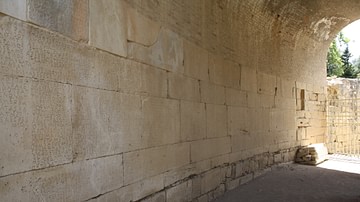
The Law Code of Gortyn, Crete
The lawcode from Gortyn, Crete was written in the 5th century BCE and is said to be the largest epigraphic text in ancient Greek (8 m x 1.70 m).
Image
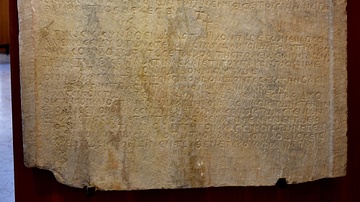
Law of Anastasius I Dicorus
Marble slab inscribed in Greek. This is the law of the Byzantine Emperor Anastasius I Dicorus (reigned 491-518 CE), regulating the passage through Dardanelles customs. Byzantine Period, 6th century CE. From Abydos, Çanakkale...

Definition
Code of Hammurabi - The Most Influential Law Code of the Ancient World
The Code of Hammurabi was a set of 282 laws inscribed in stone by the Babylonian king Hammurabi (reign 1792-1750 BCE), who conquered and then ruled ancient Mesopotamia. Although his law...

Article
Battle of Tricamarum
The Battle of Tricamarum (533 CE) was the second and last major battle of the Vandalic War (533 – 534 CE). The battle was fought between the forces of the Byzantine Empire under the leadership of the general Belisarius (500...
Definition
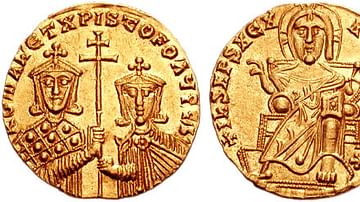
Romanos I
Romanos I Lekapenos (“the Ignorant”) was emperor of the Byzantine Empire from 920 to 944 CE. Of Armenian descent, he was a military commander who usurped the throne to rule as co-emperor with the rightful heir, but still minor, Constantine...

Image
Law Code of King Ur-Nammu
This law code is considered the oldest known law code surviving today. Many terracotta tablets of this law code have been excavated at several archaeological sites in Mesopotamia. This tablet was found at Nippur (modern...

Definition
Leo VI
Leo VI was emperor of the Byzantine empire from 886-912 CE. He was the second emperor of the Macedonian dynasty and is sometimes known as “Leo the Wise” in reference to his prolific literary output which ranged from orations to law codes...
