
Search
Remove Ads
Advertisement
Search Results

Article
Battle of Civitate
The Battle of Civitate was fought in southeastern Italy on 18 June 1053 between a papal army of Pope Leo IX (r. 1049-1054) and an outnumbered force of Norman knights seeking recognition of their conquests and titles. The Normans were victorious...
Article
Battle of Ad Decimum
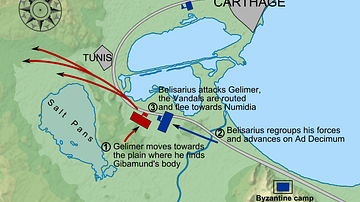
The Battle of Ad Decimum near Carthage, North Africa took place in September 533 CE and was the first major battle of the Vandalic War (533 - 534 CE) between the forces of the Byzantine Empire and the Vandal Kingdom. Leading the Vandals was...

Article
1204: The Sack of Constantinople
In 1204 CE the unthinkable happened and Constantinople, after nine centuries of withstanding all comers, was brutally sacked. Even more startling was the fact that the perpetrators were not any of the traditional enemies of the Byzantine...

Definition
Empire of Nicaea
The Empire of Nicaea was a successor state to the Byzantine Empire, or rather a Byzantine Empire in exile lasting from 1204 to 1261 CE. The Empire of Nicaea was founded in the aftermath of the sacking of Constantinople during the Fourth Crusade...

Definition
Manuel I Komnenos
Manuel I Komnenos was emperor of the Byzantine Empire from 1143 to 1180 CE. Manuel continued the ambitious campaigns of his grandfather Alexios I and father John II to aggressively expand the boundaries of his empire. Manuel turned out to...

Article
Hummingbirds in Aztec Culture - Warriors, Survivors, & the Namesakes of Gods & Kings
Hummingbirds, called huitzillin ("wee-TZEEL-een") in the Nahuatl language of the Aztecs, are one of the most recognizable and striking species in the avian world. While these pollinators are known in the Western imagination for their vibrant...

Worksheet/Activity
Arts & Culture in Medieval Japan
This activity has been designed to fit a 30-minute slot for your class and is suitable for both online and classroom teaching, as well as homeschooling. Students have to read three articles (also available in an audio format) on the three...
Article
Battle of Manzikert
The Battle of Manzikert (Mantzikert) in ancient Armenia in August 1071 CE was one of the greatest defeats suffered by the Byzantine Empire. The victorious Seljuk army captured the Byzantine emperor Romanos IV Diogenes, and, with the empire...

Definition
Belisarius
Flavius Belisarius (l. 505-565 CE) was born in Illyria (the western part of the Balkan Peninsula) to poor parents and rose to become one of the greatest generals, if not the greatest, of the Byzantine Empire. Belisarius is listed among the...

Definition
Serpent Mound
Serpent Mound (also known as Great Serpent Mound) is an archaeological and historic site in Peebles, Ohio, USA, enclosing an effigy mound 1348 feet (411 m) long in the shape of a serpent, the largest effigy mound of a serpent in the world...
