
Search
Remove Ads
Advertisement
Search Results

Definition
Lambayeque Civilization
The Lambayeque civilization (aka Sicán) flourished between c. 750 and c. 1375 CE on the northern coast of Peru, straddling the Middle Horizon and Late Intermediate Period of the ancient Central Andes. Prodigious producers...

Definition
Moche Civilization
The Moche civilization (also known as the Mochica) flourished along the northern coast and valleys of ancient Peru, in particular, in the Chicama and Trujillo Valleys, between 1 CE and 800 CE. The Moche state spread to eventually...
Definition
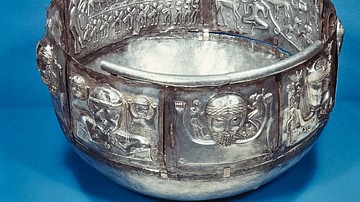
Gundestrup Cauldron
The Gundestrup Cauldron is a gilded silver bowl found in Gundestrup in Denmark in 1891 CE. It was likely made in the Balkans, perhaps in the 1st century BCE, and shows a clear influence from Celtic art and mythology, even if...

Definition
Ancient China
Ancient China produced what has become the oldest extant culture in the world. The name 'China' comes from the Sanskrit Cina (derived from the name of the Chinese Qin Dynasty, pronounced 'Chin') which was translated as 'Cin' by...

Video
Ancient Chinese Art
Maxwell Hearn, the new head of Asian Art at The Metropolitan Museum of Art, demonstrates the art of understanding and appreciating Chinese scroll paintings, among other ancient Chinese art, and how those pieces are significant...

Definition
Raphael
Raphael (1483-1520) was an Italian painter and architect who is regarded as one of the greatest of Renaissance artists alongside Michelangelo (1475-1564) and Leonardo da Vinci (1452-1519). Raphael's works are celebrated for their harmonious...

Article
Siege Warfare in Ancient India
Forts and sieges held a key position in ancient Indian warfare. Built on considerations of strategic location, topography, and the natural advantages provided by the site, forts would be heavily supplemented with man-made...

Video
Ancient Persian/Iranian Art
A superb collection of Persian-Iranian Art from a brief visit to the Metropolitan Museum of Art, New York City, USA. Including some Sumerian pieces.

Definition
Andrea Mantegna
Andrea Mantegna (c. 1431-1506 CE) was an Italian Renaissance artist most famous for his use of foreshortening and other perspective techniques in engravings, paintings, and frescoes. Another common feature of Mantegna's work is...

Video
Recent Research in Egyptian Art: Behind the Mask of Tutankhamun
Nicholas Reeves, Sylvan C. Coleman and Pamela Coleman Memorial Fellow, Department of Egyptian Art, The Metropolitan Museum of Art The magnificent gold headpiece from Tutankhamun's tomb...
